Every four years, the Laws of the Game arrive at the World Cup with refinements that ripple through the sport globally. The 2026 edition brings the most significant ruleset update since Video Assistant Referee technology was introduced at Russia 2018. New world cup 2026 rules around time management, the expanded scope of world cup 2026 var, and a confirmed carry-over of the five-substitution structure collectively reshape how the tournament will be played — and how you should interpret what happens on the pitch. This guide covers every meaningful rule at the 2026 FIFA World Cup, from the technological to the tactical.
Key Changes Since Qatar 2022
Three changes stand out from the modifications confirmed by FIFA and the International Football Association Board (IFAB) for the 2026 tournament. First, VAR’s powers have been expanded — referees can now initiate reviews for second yellow card incidents and incorrectly awarded corner kicks that were previously outside VAR’s scope. Second, new time-management enforcement rules — including a five-second countdown for throw-ins and goal kicks — directly address the time-wasting tactics that plagued extended periods of Qatar 2022. Third, a strict substitution exit rule (discussed in detail below) targets the cynical slow walk that added minutes of lost time in high-pressure group stage finales.
What has not changed is equally notable. IFAB considered but ultimately rejected Arsène Wenger’s proposed offside rule amendment, which would have changed the rule so a player is onside as long as any part of their body capable of playing the ball is level with (rather than ahead of) the last defender. This would have reduced the number of marginal offside calls significantly. IFAB concluded that further testing was required before tournament implementation, meaning the current law — any part of an attacking player ahead of the last defender constitutes offside — remains in force at the 2026 World Cup. The traditional world cup 2026 offside standard remains unchanged.
The 48-team format itself is a structural change rather than a Laws of the Game change, but it affects certain rule applications — specifically the yellow card accumulation and reset cycle, which is calibrated to the new round structure rather than the traditional Quarter-Final system.
VAR and Semi-Automated Offside Technology
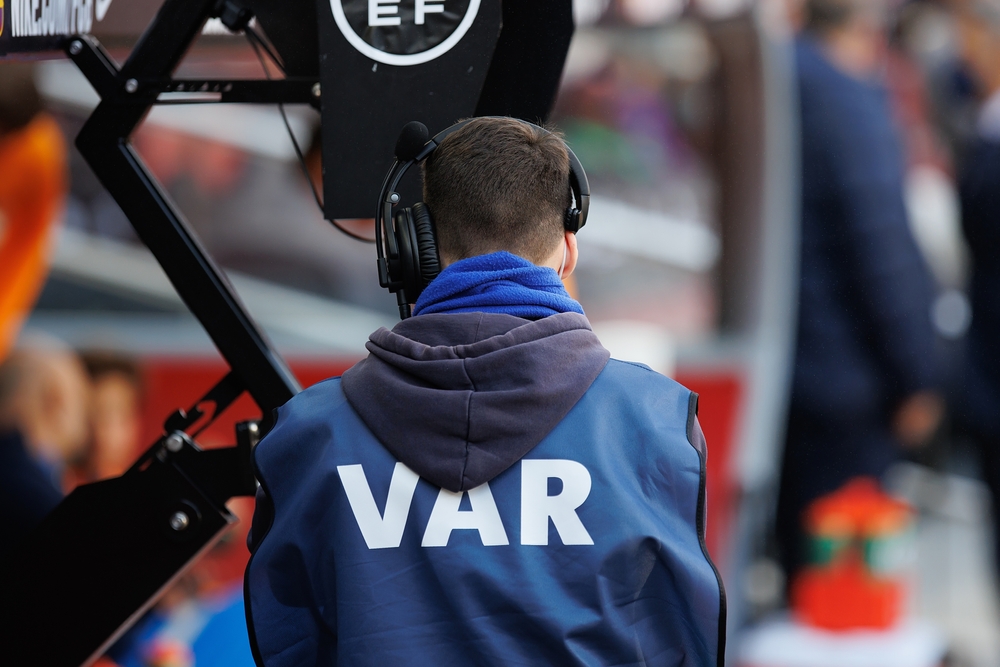
World cup 2026 var arrives in its most technically sophisticated form to date. The Video Assistant Referee system — which intervenes on goals, penalty decisions, direct red cards, and mistaken identity — continues as the primary officiating support tool, but its expanded scope for 2026 adds two categories previously outside its review powers.
VAR referees can now recommend an on-field review for second yellow card incidents — situations where the VAR considers the initial yellow to be incorrect and a dismissal is warranted. Previously, second yellows were outside VAR’s scope entirely, creating a well-documented loophole where tactical fouling accumulated without technology-supported correction. From 2026, a player who receives a second yellow that VAR identifies as a clear and obvious error can be upgraded to a red card after review.
VAR can also now flag and review an incorrectly awarded corner kick, provided the review can be completed immediately without delaying the restart. This targets the specific scenario where a deflected cross — correctly off an attacking player — is awarded as a corner when the last touch was clearly from the attacking side. Corner kick errors generated several significant match-altering moments in Qatar 2022 and are now within the review framework.
Semi-Automated Offside Technology (SAOT) continues from Qatar 2022 in an enhanced form. SAOT uses a network of tracking cameras capturing 29 data points per player, combined with a chip sensor embedded in the match ball recording contact at 500 times per second. The system identifies the exact moment of the pass, maps every player’s skeletal position at that moment, and calculates offside or onside in seconds rather than the several minutes required by manual VAR lines. The result: world cup 2026 offside decisions are both faster and more accurate than any previous tournament.
For bettors, the VAR regime at the 2026 World Cup has direct implications. Penalty decisions — already one of the most VAR-reviewed categories — are now scrutinized with higher-definition camera arrays and faster processing. If you are placing pre-match or in-play wagers that depend on penalty outcomes, clean sheet odds, or red card markets, the expanded VAR framework increases the probability that marginal incidents are correctly adjudicated rather than missed in real time.
Substitutions: The 5+1 Rule
How many substitutes world cup 2026 allows per team per match: five standard substitutions, plus one concussion substitution — the “5+1” structure that debuted at Qatar 2022 and is confirmed to continue.
The five standard substitutions can be made across a maximum of three separate stoppages within the 90 minutes, plus at half-time. This means a coach can make all five changes in three of the four available windows (three in-game stoppages plus the half-time break) but cannot make one substitution at a time five separate times. The three-stoppage limit prevents excessive interruptions to match flow while allowing full tactical flexibility. Both teams share the right to simultaneously make substitutions during the same stoppage window without it counting as a separate stoppage for either side.
The concussion substitution is a sixth change available outside the standard five. It is triggered when a player is assessed for a suspected concussion. Both teams are entitled to make a concussion substitution in a match where one has been triggered — preventing the situation where only the team with the injured player benefits from the extra option. In extra time, an additional standard substitution is permitted beyond the five used in regulation.
The new exit rule for 2026: when a substitution is signalled, the player leaving the field must exit within 10 seconds. If they fail to do so, the incoming substitute must wait on the touchline for one full minute before entering, temporarily reducing the team to ten players. This measure directly targets the deliberate time-wasting behaviour where departing players shuffled to the exit at walking pace in the closing stages. Referees are required to enforce the 10-second countdown visibly and consistently.
Squad Size: 26 Players
World cup 2026 squad size is set at 26 players per nation — three more than the 23-player limit that applied from 1998 through the 2018 World Cup in Russia. The 26-player roster was first used at Euro 2020 (played in 2021) and carried into Qatar 2022 with FIFA’s endorsement. It is now a confirmed permanent feature of the World Cup structure.
The additional three roster spots provide coaches meaningful tactical optionality. A typical 26-man roster includes three goalkeepers, eight defenders, eight midfielders, and seven attackers in various formations — though no specific positional quota is mandated. Coaches routinely use the extra spots to insure against tournament injuries at specialist positions, carry an additional set-piece delivery specialist, or include a tactically specific player whose role only emerges if the team reaches the knockout rounds.
For Canada, the 26-player roster is particularly relevant given the squad’s relative depth uncertainty at certain positions. Les Rouges’ qualifying campaign leaned heavily on a core of 15 to 17 starters, but the expanded roster allows coach Jesse Marsch to carry developing players who may emerge as impact substitutes during a long tournament run. Every spot on a 26-man World Cup roster carries career-defining weight for the player selected.
Yellow Card Accumulation Rules
Yellow cards accumulate across the group stage and Round of 32 under the 2026 rules. A player who receives two yellow cards in separate matches during this phase is automatically suspended for the next match. Yellow cards are wiped clean after the Round of 16 — meaning a player who enters the quarterfinals with one yellow card from an earlier round carries no suspension risk from that booking into the quarterfinals.
The reset point is specifically designed so that no player is suspended for a quarterfinal, semifinal, or the Final due to accumulated bookings in earlier rounds. Only a yellow card received in those later matches themselves would generate a one-match ban for the subsequent fixture. This rule prevents the scenario — seen in previous editions — where a top player deliberately receives a yellow card to clear their slate before a major knockout game, though the reset itself means such gamesmanship is less likely to arise.
Red cards — whether straight red or second yellow — carry an automatic one-match suspension at minimum. The disciplinary committee can extend suspensions for serious foul play, violent conduct, or other aggravated offences reviewed after the match. There is no automatic red card wipe at any point in the tournament; a player sent off in the Final could theoretically begin the next World Cup under suspension (though such cases are historically rare and subject to appeals).
Extra Time and Penalties
In knockout rounds where the score is level after 90 minutes of regulation, the match proceeds to 30 minutes of extra time divided into two 15-minute halves. There is no golden goal rule — both halves of extra time are played to completion regardless of goals scored. Each coach may make one additional substitution in extra time, beyond the five permitted in regulation, for a maximum of six total changes (seven if a concussion sub was also used). This extra-time substitution is specifically to manage fatigue in what may be a fourth or fifth match for some players over a three-week period.
If the score remains level after extra time, the match is decided by a penalty shootout. Penalties alternate between the two teams, with each side taking five penalties in the first round. If still level, the shootout continues on a sudden-death basis — one kick per team until one side scores and the other misses. All outfield players who remain on the pitch at the conclusion of extra time are eligible to take penalties; neither goalkeeper is excluded from the shootout rotation.
Goalkeepers may move laterally along the goal line during a penalty kick but cannot advance forward of the goal line before the ball is struck. This rule — enforced more rigorously in recent tournaments with VAR support — generated controversy at Qatar 2022 when several goalkeeper infractions technically qualified for retaliation kicks but were not consistently flagged. IFAB has confirmed that VAR will monitor goalkeeper position during penalty shootouts at the 2026 World Cup.
Match Ball
The official match ball for the 2026 FIFA World Cup is the Adidas Trionda, unveiled in October 2025. The name derives from the Spanish for “three waves” — a direct tribute to the three host nations: Canada, the United States, and Mexico. Adidas has been FIFA’s official match ball supplier since 1970, and the Trionda continues the tradition of embedding Connected Ball Technology: a chip sensor that records the ball’s precise position 500 times per second, feeding the Semi-Automated Offside Technology system in real time. The outer panel construction is designed to maintain consistent flight characteristics across the wide range of weather and altitude conditions the ball will encounter across 16 venues in three countries.
For goalkeepers, the ball’s aerodynamic profile at altitude — specifically at Mexico City’s Estadio Azteca at 2,240 metres — will be a significant preparation consideration. Previous World Cup tournaments have seen knuckling and unpredictable trajectories at altitude, and goalkeepers competing in Mexican venues will need specific preparation for those conditions.
The Rulebook at a Glance
The 2026 World Cup world cup 2026 rules package is the most spectator-friendly ever assembled for a FIFA tournament. Faster offside decisions, broader VAR coverage, crackdowns on time-wasting, and a five-substitution tactical environment collectively produce a more fluid, higher-quality product than any previous edition. For Canadian fans watching Les Rouges navigate Group B and potentially beyond, understanding these rules — particularly how VAR reviews affect penalty decisions and how yellow card accumulation builds across the tournament — adds genuine depth to every match. For the full tournament structure and format, see our World Cup 2026 format guide, and for the complete World Cup 2026 hub including odds and analysis, visit our main guide.