Nearly a century of drama, heartbreak, and brilliance is woven into the fabric of world cup history. Since Uruguay lifted the first trophy in Montevideo in 1930, the FIFA World Cup has grown from a 13-team experiment into the single most watched sporting event on earth. Twenty-two editions, eight different champion nations, and countless moments of sporting genius have made this tournament the permanent backdrop against which soccer’s greatest stories are told. As the 2026 edition arrives in North America, it is worth tracing the full arc of how we got here – and understanding what makes the World Cup unlike anything else in sport.
Nearly 100 Years of Soccer’s Greatest Stage
The FIFA World Cup was born from a power struggle. European nations had dominated the Olympic soccer tournaments of the 1920s, and FIFA president Jules Rimet pushed for an autonomous championship that would crown a true world champion rather than an Olympic side-event winner. Uruguay, celebrating its centenary of independence and boasting a double Olympic title, was selected as the inaugural host in 1930. Only 13 nations made the expensive Atlantic crossing, and the host nation duly won – setting a pattern that would repeat itself in surprising ways across the decades.
The pre-war era produced two Italian triumphs (1934 and 1938), both under coach Vittorio Pozzo and both wrapped in the political shadow of Mussolini’s Italy. After the tournament returned in 1950 following a 12-year pause caused by the Second World War, the game shifted on its axis. Brazil hosted and were expected to win comfortably. What happened next became one of the defining shocks in world cup history: a final-round upset by Uruguay in the Maracanã that left 200,000 spectators stunned into near silence. The Brazilians called it the Maracanazo – the Maracanã blow – and the trauma of that defeat haunted a generation.
The 1950s and 1960s saw the emergence of Brazil as the tournament’s dominant force, with Pelé arriving on the world stage at just 17 years old in Sweden in 1958 – the youngest goalscorer in World Cup final history at that point. England hosted and won in 1966 amid controversy. The 1970s and 1980s oscillated between the brilliance of West Germany’s engineering and Argentina’s street-level genius. By the 1990s, the World Cup had gone global in a way Jules Rimet could never have imagined: hosted in the United States (1994), Japan and South Korea (2002), South Africa (2010), and Brazil (2014). The world cup winners list now spans three continents and eight nations – and the 2026 tournament, the first to expand to 48 teams, promises to add new names to that roll of honour.
All World Cup Winners Since 1930
Below is the complete world cup winners record across all 22 editions. Eight nations appear on this list – a striking illustration of just how difficult it is to reach the very top of the game on the world’s biggest stage.
| Year | Host Country | Winner | Runner-Up | Score (Final) |
| 1930 | Uruguay | Uruguay | Argentina | 4-2 |
| 1934 | Italy | Italy | Czechoslovakia | 2-1 (AET) |
| 1938 | France | Italy | Hungary | 4-2 |
| 1950 | Brazil | Uruguay | Brazil | 2-1 (Final Round) |
| 1954 | Switzerland | West Germany | Hungary | 3-2 |
| 1958 | Sweden | Brazil | Sweden | 5-2 |
| 1962 | Chile | Brazil | Czechoslovakia | 3-1 |
| 1966 | England | England | West Germany | 4-2 (AET) |
| 1970 | Mexico | Brazil | Italy | 4-1 |
| 1974 | West Germany | West Germany | Netherlands | 2-1 |
| 1978 | Argentina | Argentina | Netherlands | 3-1 (AET) |
| 1982 | Spain | Italy | West Germany | 3-1 |
| 1986 | Mexico | Argentina | West Germany | 3-2 |
| 1990 | Italy | West Germany | Argentina | 1-0 |
| 1994 | United States | Brazil | Italy | 0-0 (AET, 3-2 pens) |
| 1998 | France | France | Brazil | 3-0 |
| 2002 | South Korea / Japan | Brazil | Germany | 2-0 |
| 2006 | Germany | Italy | France | 1-1 (AET, 5-3 pens) |
| 2010 | South Africa | Spain | Netherlands | 1-0 (AET) |
| 2014 | Brazil | Germany | Argentina | 1-0 (AET) |
| 2018 | Russia | France | Croatia | 4-2 |
| 2022 | Qatar | Argentina | France | 3-3 (AET, 4-2 pens) |
The pattern is revealing: every champion except England, Spain, France, and Uruguay has won the tournament more than once. South American nations have triumphed 10 times; European nations, 12 times. No African, Asian, or CONCACAF nation has ever won – a gap that the expanded 48-team format is designed to eventually challenge.
The Most Successful Nations in World Cup History
When fans debate who has won the most World Cups, one answer is so dominant it barely requires discussion: Brazil, with five titles, stands alone at the summit of world cup history. But the full picture is more nuanced, and understanding it helps bettors calibrate expectations for 2026.
Brazil – 5 Titles (1958, 1962, 1970, 1994, 2002)
The Seleção’s five championships span seven decades and represent soccer at its most aesthetically elevated. The 1958 tournament in Sweden introduced Pelé to a disbelieving world – he scored twice in the final at 17, the youngest player to score in a World Cup final. The 1962 edition confirmed Brazil’s dominance even without an injured Pelé for much of the tournament. But it is 1970 in Mexico – with Pelé, Jairzinho, Tostão, Rivelino, and Carlos Alberto – that most historians consider the pinnacle of the game. That team lost just one player across the tournament and scored 19 goals in six matches, finishing 4-1 against Italy in a final that felt like an exhibition. After a 24-year gap, Brazil returned as champions in 1994 in the United States – winning on penalties against Italy after a goalless final. The fifth title came in Japan and South Korea in 2002, with a Ronaldo-led side steamrolling opponents. Since 2002, however, Brazil has not returned to a final, suffering most famously with the 7-1 semifinal demolition at the hands of Germany on home soil at the world cup 2014 – an event branded the Mineirazo.
Germany – 4 Titles (1954, 1974, 1990, 2014)
Germany – or West Germany as they were during the first three championships – embody competitive relentlessness. In 1954, they overcame a tournament-favourite Hungarian side 3-2 in the final despite having lost to the same team 8-3 in the group stage. The “Miracle of Bern” remains one of sport’s great upsets. The 1974 title came on home soil, with Franz Beckenbauer captaining a side that had Total Football in its DNA. Reunified Germany won in 1990 – a workmanlike title over Argentina in a famously dull final. And in 2014 on Brazilian soil, a Götze extra-time winner delivered a fourth star. Germany have reached the final eight times in total, and their consistency across eras makes them a permanent top-10 betting proposition at every tournament.
Italy – 4 Titles (1934, 1938, 1982, 2006)
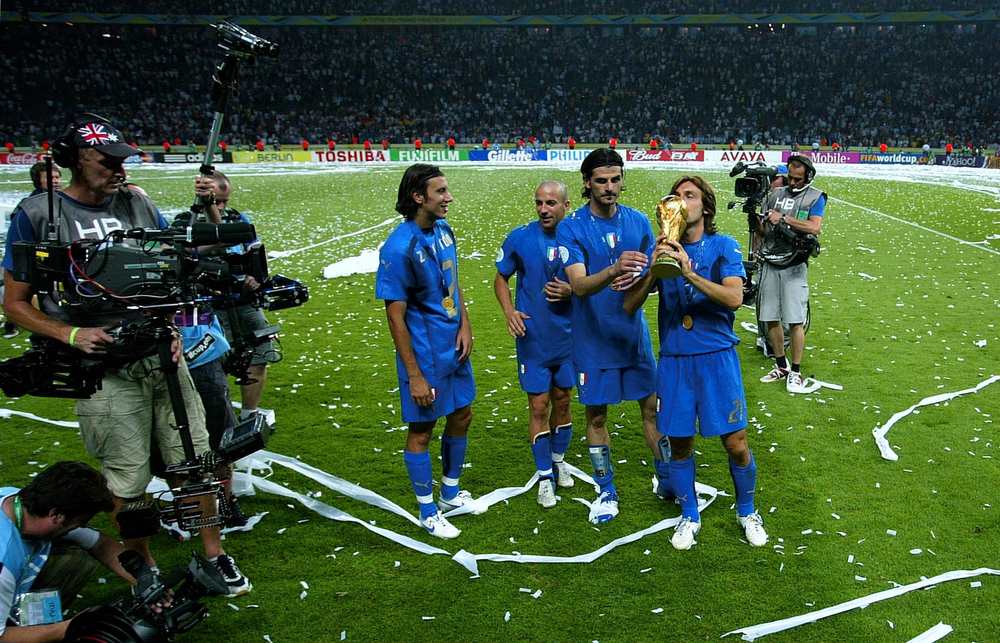
The Azzurri’s record mirrors Germany’s in title count, though their path to glory has often been more grinding than glorious. The 1934 and 1938 back-to-back titles were achieved under enormous political pressure. The 1982 redemption story – with Paolo Rossi emerging from a match-fixing ban to score six goals in three games – is one of the tournament’s great individual arcs. And the 2006 title in Germany was built on a defensive fortress that conceded just two goals in seven matches, one of them an own goal. Italy’s absence from the world cup 2018 – failing to qualify outright for the first time since 1958 – underscored how quickly generational cycles can collapse even the most storied programs.
Argentina – 3 Titles (1978, 1986, 2022)
Each of Argentina’s three titles came in a different era, with a different emotional register. The 1978 home tournament was shadowed by political controversy under the military junta. The 1986 triumph in Mexico was essentially Diego Maradona operating alone at a level no individual player has matched before or since – he scored ten goals and set up ten more across the tournament. The 2022 title in Qatar was the catharsis of a generation: Lionel Messi, at his final World Cup, leading Argentina past France in the most dramatic final since 1966, coming back from 2-0 down to tie at 3-3 in extra time before winning on penalties. That final – a match featuring two hat-tricks (Mbappé for France, and a hat-trick of penalties for Messi) – is already considered among the greatest sporting events ever broadcast.
France – 2 Titles (1998, 2018)
France have won when they have had the right multicultural blend of steel and flair. The world cup 2018 in Russia saw Didier Deschamps construct a team that sacrificed attacking beauty for competitive ruthlessness – winning 4-2 in the final against Croatia, though the scoreline flatters France’s dominance less than it reflects Croatia’s remarkable resilience. With Kylian Mbappé now in his prime, France enter every tournament as genuine favourites.
Uruguay and England – 2 and 1 Titles
Uruguay’s pair of titles (1930 and 1950) make them the most decorated nation relative to their population and resources. England’s sole triumph in world cup 1966 on home soil – Geoff Hurst’s hat-trick in a 4-2 final – remains the country’s only major international honour, and its pursuit of a second title has become one of sport’s great ongoing narratives. Spain’s solitary 2010 crown was built on tiki-taka possession football that averaged over 60% possession per game – a stylistic revolution that reshaped how coaches thought about the game.
🇨🇦 Canada at the World Cup: 1986, 2022 and the Dream of 2026
Canada’s world cup history is short in tournament appearances but enormous in emotional weight. For a nation that has spent decades proving it belongs in the conversation of serious soccer countries, the next few weeks represent a culmination unlike anything the program has experienced.
For full detail on Les Rouges’ journey from the fields of Mexico to the streets of Vancouver, visit our dedicated Canada World Cup history page. Here is the essential timeline.
Canada at World Cup 1986 – Debut in Mexico
It took Canada 56 years after the World Cup’s founding to qualify for the first time. The canada world cup 1986 appearance was the result of a CONCACAF qualification campaign that sent an inexperienced, largely amateur Canadian side to Group C in Mexico alongside France, the Soviet Union, and Hungary. Coach Tony Waiters built a team with grit but limited attacking quality at the international level, and the results reflected the gap. Canada lost all three group games – 0-1 to France, 0-2 to Hungary, and 0-2 to the Soviet Union – without scoring a single goal in 270 minutes of World Cup soccer. Five goals conceded, zero scored, zero points. By any measure it was a difficult debut. But qualifying at all – beating the Americans and Hondurans to reach Mexico – was the genuine achievement, and it planted a seed in Canadian soccer culture that would take another 36 years to fully bloom.
Canada at World Cup 2022 – Return to the Stage in Qatar
The canada world cup 2022 campaign was the moment a new generation announced itself to the planet. Drawn into Group F alongside Belgium, Croatia, and Morocco, John Herdman’s side walked into their opening match against Belgium carrying decades of pent-up national expectation. Alphonso Davies earned a penalty inside the opening minutes – a moment that set the Al Rayyan stadium buzzing – only to see it saved by Thibaut Courtois. Belgium won 1-0, but Canada’s performance showed they belonged. The tournament ended in the group stage, with Croatia and Morocco advancing, but the squad – featuring Davies, Jonathan David, Stephen Eustáquio, Tajon Buchanan, and goalkeeper Milan Borjan – showed enough to make 2026 feel genuinely possible rather than aspirational.
Canada at World Cup 2026 – Home Soil, Home Expectations
Now, as co-hosts, Canada enters their third World Cup carrying a weight of expectation that no Canadian soccer team has ever navigated. The home crowd at Vancouver’s BC Place, the familiarity of the time zones, the absence of gruelling travel – these are real advantages. But so is the pressure of a nation watching in real time. Alphonso Davies is at peak age. Jonathan David is one of Europe’s most clinical strikers. The question is not whether Canada will compete – it is how far they can go.
Ver esta publicación en Instagram
World Cup Records That Will Stand for Years
The statistical architecture of world cup records is as fascinating as the tournament itself. Some numbers define eras; others define individuals.
Most Goals in Tournament History – Miroslav Klose (16)
Germany’s Miroslav Klose stands alone as the world cup top scorers all time leader with 16 career goals across four tournaments (2002, 2006, 2010, 2014). He overtook Brazil’s Ronaldo (15) in the 2014 semifinal – the same night Germany humiliated Brazil 7-1. Klose’s record is built on efficiency rather than spectacle: he scored with his head, his left foot, his right foot, and he rarely wasted a clear chance.
Most Goals in a Single Tournament – Just Fontaine (13)
Just Fontaine’s 13 goals for France at the 1958 World Cup in Sweden is a single-tournament record that has never been approached in the 68 years since. Fontaine was essentially a replacement player – he only started because René Bliard was injured – and he ended up top scorer with goals in every game. The record may never fall given that modern tournaments, even with 48 teams, do not produce the same open defensive environments of the 1950s.
Fastest Goal – Hakan Şükür (11 Seconds)
Turkey’s Hakan Şükür scored 11 seconds into the 2002 third-place playoff against South Korea, the fastest goal in World Cup history. It was an almost comically rapid start to a match that Turkey won 3-2.
Highest Score – Hungary 10-1 El Salvador (1982)
In the world cup 1982 in Spain, Hungary demolished El Salvador 10-1 in a group stage game that remains the tournament’s most lopsided result. László Kiss scored a hat-trick as a substitute.
Youngest Goalscorer – Pelé (17 Years, 239 Days)
Pelé scored in the 1958 World Cup final against Sweden at 17 years and 239 days old, making him the youngest player to score in a World Cup final – a record that remains intact.
Youngest Player – Norman Whiteside (17 Years, 41 Days, 1982)
Northern Ireland’s Norman Whiteside became the youngest player ever to appear at a World Cup at 17 years and 41 days old in 1982 in Spain, surpassing Pelé’s own record of 1958.
The Moments That Changed Everything
World Cup history is ultimately a collection of moments – flashes of individual genius or collective implosion that permanently alter the tournament’s narrative gravity.
The Maracanazo, 1950
The 1950 World Cup used a final round-robin rather than a knockout final, and Brazil went into their decisive match against Uruguay needing only a draw to win the tournament. An estimated 200,000 fans packed the Maracanã – the largest single attendance in World Cup history – expecting a coronation. Uruguay won 2-1. The silence that followed the final whistle was described by journalists as one of the most eerie sounds sport had ever produced. Brazil’s white kit was abandoned afterwards and replaced with the iconic yellow and green – a direct consequence of the psychological trauma of that afternoon.
Maradona’s Double, 1986
In the world cup 1986 quarterfinal between Argentina and England at the Azteca in Mexico City, Diego Maradona scored two of the most discussed goals in soccer history within four minutes of each other. The first – punched in with his left hand while the referee looked elsewhere – he later called “the hand of God.” The second – a solo run from his own half, beating five English outfield players and the goalkeeper across 60 metres in 10 seconds – has been repeatedly voted the greatest goal in World Cup history. That single match contains more drama than most entire tournaments.
The Mineirazo, 2014
Brazil 1-7 Germany in a World Cup semifinal, on Brazilian soil, in front of a Belo Horizonte crowd that had prepared for a victory party. What unfolded was the most unexpected demolition in modern tournament history. Germany scored four goals in six minutes during the first half. Five different German players scored. Miroslav Klose broke the all-time World Cup goals record during the rout. The silence of the Brazilian crowd, the tears in the stands, the sheer dislocation of the scoreboard – this was the world cup 2014’s defining image, and it reset how the world thought about Brazil’s fragility without Neymar and Thiago Silva.
Morocco’s Semifinal Run, 2022
The 2022 World Cup in Qatar delivered its most thrilling narrative through Morocco – the Atlas Lions – who became the first African nation in history to reach the semifinals. They knocked out Belgium, Spain, and Portugal – three former World Cup winners or finalists – on their way. Coach Walid Regragui built a team that conceded just one goal from open play throughout the tournament, relying on collective defensive structure rather than individual stars. The matches against Spain and Portugal were played in front of overwhelmingly pro-Morocco crowds from the Arab world. The run ended against France in the semifinals, but the impact on African soccer’s global standing was immeasurable – and Morocco’s 2026 campaign will carry enormous expectations as a result.
The 2022 Final – The Greatest Final Ever Played
Argentina versus France in the world cup 2022 final may be the finest 120 minutes of World Cup soccer ever contested. Argentina led 2-0 with 10 minutes left through goals from Di María and Messi. Kylian Mbappé then scored twice in 97 seconds to level – one from the penalty spot, one from a stunning volley – forcing extra time. Messi restored Argentina’s lead; Mbappé equalized again with another penalty to complete his hat-trick. In the shootout, Argentina prevailed 4-2 on penalties, and Messi finally had his World Cup. The match had everything: tactical chess, individual brilliance, momentum swings, and a denouement that left broadcasters worldwide speechless.
What History Tells Us About 2026
The patterns of world cup history offer a few reliable truths heading into 2026. Home advantage matters – host nations have won the tournament six times (Uruguay, Italy, England, West Germany, Argentina, France). Expanded formats tend to produce surprise nations in the later rounds – the move to 48 teams is the biggest structural change since the jump from 16 to 24 in 1982. And the best teams do not always win: the gap between the tournament favourites and the eventual world cup winners is smaller than betting markets typically reflect. For Canadians watching from a home stadium for the first time, that history is both thrilling and instructive. Follow the World Cup 2026 hub for all betting analysis, odds, and team previews as the tournament unfolds.