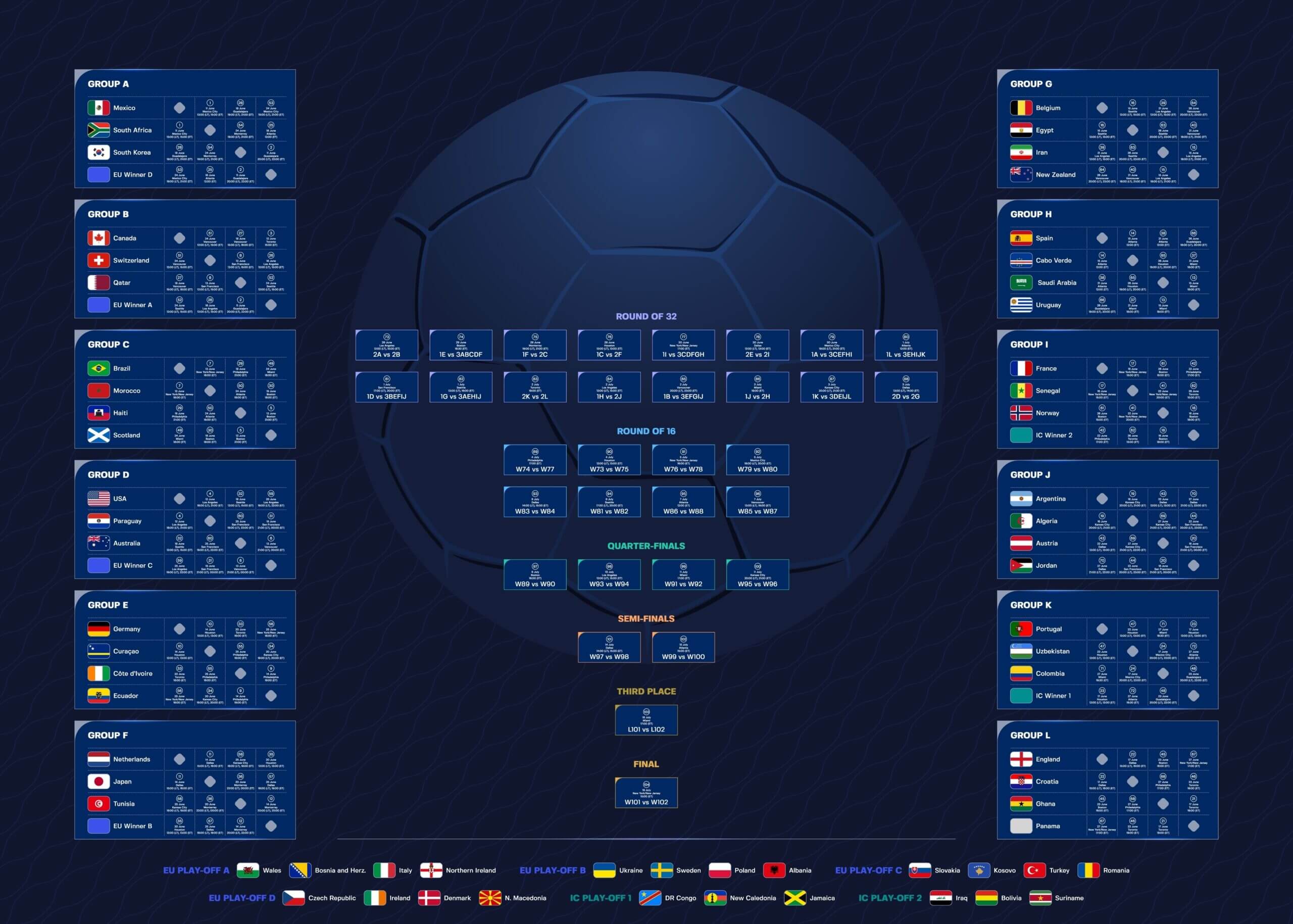
When FIFA confirmed the 48-team expansion for World Cup 2026, one number captured the tournament’s scale better than any other: 104. That’s how many individual matches will be played between the opening kickoff in June and the final whistle at MetLife Stadium in July. Sixty-four was the gold standard for a generation; 104 changes the arithmetic of everything – broadcast scheduling, team preparation, tournament economics, and the depth of betting markets available to Canadian fans across a five-week window. Here’s the complete breakdown of how those 104 world cup 2026 matches are structured, distributed, and scheduled.
How Many Matches in World Cup 2026 – How 104 Games Break Down by Stage
The 104-match total follows directly from the tournament’s structure: 12 groups of four teams producing 72 group-stage games, followed by a five-round knockout competition. The arithmetic is clean:
| Stage | Matches | Teams Entering | Teams Advancing |
| Group Stage | 72 | 48 | 32 |
| Round of 32 | 16 | 32 | 16 |
| Round of 16 | 8 | 16 | 8 |
| Quarter-Finals | 4 | 8 | 4 |
| Semi-Finals | 2 | 4 | 2 |
| Third-Place Match | 1 | 2 | – |
| Final | 1 | 2 | Champion |
| Total | 104 | – | – |
Each group produces six matches – every combination of the four teams plays once – which is why 12 groups generate exactly 72 group-stage games. The group stage alone accounts for 69% of the tournament’s total match volume. For broadcasters, this means six weeks of near-daily live soccer content, compared to Qatar 2022’s 48 group games. For bettors, it means the most sustained period of match-by-match betting activity in the sport’s calendar.
Compared to previous editions, the growth in match count is significant. The 24-team format (1982-1994) produced 52 matches. The 32-team format (1998-2022) standardized at 64. The jump to 104 is the largest single-edition increase in tournament history.
Ver esta publicación en Instagram
Match Distribution Across the 16 Host Cities
The 104 matches will be spread across 16 venues, with the highest-profile stadiums receiving more fixtures – particularly in the knockout rounds where broadcast value is highest. The three Mexican stadiums and three Canadian venues will primarily host group-stage and earlier knockout matches; the large American venues will anchor the knockout rounds and the final.
Canadian venues:
| City | Venue | Approx. Capacity |
| Vancouver | BC Place | ~54,500 |
| Toronto area | BMO Field | ~28.500 |
American venues:
| City | Venue | Capacity |
| New York/New Jersey | MetLife Stadium | 82,500 |
| Los Angeles | SoFi Stadium | ~70,000 |
| Dallas | AT&T Stadium | 80,000+ |
| Miami | Hard Rock Stadium | ~65,000 |
| Seattle | Lumen Field | ~69,000 |
| Boston | Gillette Stadium | ~65,000 |
| Philadelphia | Lincoln Financial Field | ~69,000 |
| Kansas City | Arrowhead Stadium | ~76,000 |
| Atlanta | Mercedes-Benz Stadium | ~71,000 |
Mexican venues:
| City | Venue | Capacity |
| Mexico City | Estadio Azteca | ~87,000 |
| Guadalajara | Estadio Akron | ~49,000 |
| Monterrey | Estadio BBVA | ~53,000 |
MetLife Stadium is widely expected to host the Final on July 19, 2026, which would make it one of the largest-audience events in the stadium’s history. The Estadio Azteca’s tournament return is historically significant: it becomes the only stadium to have hosted matches in three separate World Cups (1970, 1986, and 2026).
Ver esta publicación en Instagram
Schedule Overview: Canadian Broadcast Windows
The tournament is projected to run from approximately June 11 to July 19, 2026. For Canadian fans, the time zone alignment is the single most transformative difference from Qatar 2022. Every match in 2026 falls within Canadian time zones – Eastern (ET), Central (CT), Mountain (MT), and Pacific (PT) – meaning game times will land in morning, afternoon, and evening slots rather than the late-night windows that complicated 2022 viewership.
Typical daily kickoff windows during the group stage will likely include slots at approximately 12:00 PM ET, 3:00 PM ET, and 6:00 PM ET, with some evening matches at 9:00 PM ET for western venues. Multiple simultaneous matches will occur, particularly in the final group-stage round where all same-group games kick off concurrently.
TSN, CTV/CBC, and RDS (French-language) will provide live coverage, with DAZN offering streaming access for viewers who prefer the digital platform. For Canadian bettors, this means in-play wagering on live matches at normal waking hours for the first time at a World Cup – a significant upgrade in the live betting experience.
Travel and Logistics Challenges Across the Tournament
The three-nation format creates logistical complexity that no previous World Cup has imposed on either teams or fans. A national team could theoretically play its three group-stage games in three different countries – Vancouver, a US city, and Mexico City, for example – requiring international travel between matches within a nine-day window. The physical and organizational demands of cross-border travel, altitude adjustment (Mexico City sits at 2,240 metres above sea level), and time zone shifts across the continent will be genuine competitive variables.
FIFA will work to minimize the most extreme travel demands through scheduling, but given the number of host cities and teams, some groups will have more geographically challenging distributions than others. Nations scheduled to play at Mexico City’s Azteca during the group stage face a distinct challenge: altitude of 2,240 metres measurably affects athletic performance in teams from sea-level nations, particularly in the first match at elevation. This effect typically diminishes significantly with 48-72 hours of acclimatization, but a team arriving into Mexico City 24 hours before kick-off has far less buffer.
For travelling fans, the financial and logistical demands of following a team across three countries are substantial. Peak-season flights between Vancouver and Dallas, or between an American city and Mexico City, during the tournament window will command premium prices. Accommodation in host cities during match windows is already being speculated about as extremely competitive. Canadian fans planning in-person attendance should build budget flexibility into any plans made more than 18 months in advance.
Betting Insights Built Around the Match Structure
The match count and distribution of world cup 2026 matches creates specific betting considerations that didn’t exist in the 32-team format:
Altitude markets at Azteca: Games at Mexico City’s Estadio Azteca carry a unique physical variable. Teams from sea-level nations – particularly European sides unaccustomed to altitude – show measurable performance decline in the first half at elevation. Under 2.5 first-half goals and under 0.5 first-half goals markets in Azteca group-stage fixtures involving European debutants at altitude deserve close examination relative to flat-ground market equivalents.
Weather and endurance factors at Dallas and Miami: AT&T Stadium in Arlington is climate-controlled indoors, neutralizing the June heat factor that an open-air Dallas venue would create. Hard Rock Stadium in Miami does not have a retractable roof, meaning summer humidity and heat create genuine endurance variables in evening kickoffs.
Volume plays on total games: With 104 matches, any bettor placing consistent small-stake unit bets across a large sample of group-stage games – applying consistent, statistically validated filters – has more market opportunities than at any previous World Cup. The law of large numbers starts to apply meaningfully at 72 group-stage games in a way it simply didn’t across 48.
Fixture congestion for advancing teams: Teams that advance to the Round of 32 face the possibility of playing four matches in roughly 14 days during the group stage plus Round of 32 window. Monitoring lineup rotation, published injury reports, and training session access becomes more important earlier in 2026 than in previous tournaments.
The complete world cup schedule 2026 will be published as soon as FIFA confirms kickoff times and venue assignments. Detailed profiles and logistics guides for each of the 16 host cities are available in our dedicated section.