France arrives at the 2026 World Cup as one of only two teams that genuinely belong in the conversation about lifting the trophy in July – and their claim is grounded in evidence that goes well beyond reputation. Les Bleus have contested four of the last seven World Cup finals, winning two of them. They possess the deepest squad in international football, with a bench that would comfortably start for most other nations in this tournament. And in Kylian Mbappé, they have the most dangerous attacking player on the planet at the peak of his powers. This is not a team building toward future glory. This is a team that came to win – and Didier Deschamps, coaching his final World Cup before handing the reins to Zinedine Zidane, will want nothing less than a third title to close one of the most successful international coaching careers in the history of the sport.
France’s Road to 2026: Dominant Qualifying, Unfinished Business
France qualified for the 2026 World Cup through UEFA’s European qualifying rounds, completing their campaign with commanding authority against a group that, while not featuring the continent’s elite, provided the competitive context Deschamps needed to assess his squad depth and test his tactical rotations.
Drawn into Group D of UEFA qualifying alongside Ukraine, Iceland, and Azerbaijan, France handled their qualification obligations with professional efficiency. A 5-1-0 record across six matches – including wins over Ukraine, who are no straightforward opponent – produced 16 points from a possible 18, with the only dropped points coming in a draw against a side that caused several more fancied European nations problems during this qualifying cycle.
The narrative around france world cup 2026 is shaped not just by the qualifying record but by what happened in the two preceding tournaments. France won the World Cup in Russia in 2018. They then reached the final in Qatar 2022 and lost a remarkable match against Argentina on penalties after fighting back from 2-0 down in the second half. That final at Lusail – arguably the greatest World Cup final ever played – ended in defeat, and the best players in France’s golden generation have spent three years with the image of Mbappé’s hat-trick not being enough to win the trophy fixed firmly in their minds. That unfinished business gives this squad a motivation that statistical models cannot measure.
Deschamps has confirmed that he will step down as coach after the 2026 tournament, ending a 14-year tenure that will be evaluated against the standard he himself created: the title in 2018. A second championship in his farewell tournament would place him alongside Mario Zagallo and Franz Beckenbauer as the only people to win the World Cup as both player and coach – and then do it twice. That is the context in which every France result in 2026 should be interpreted.
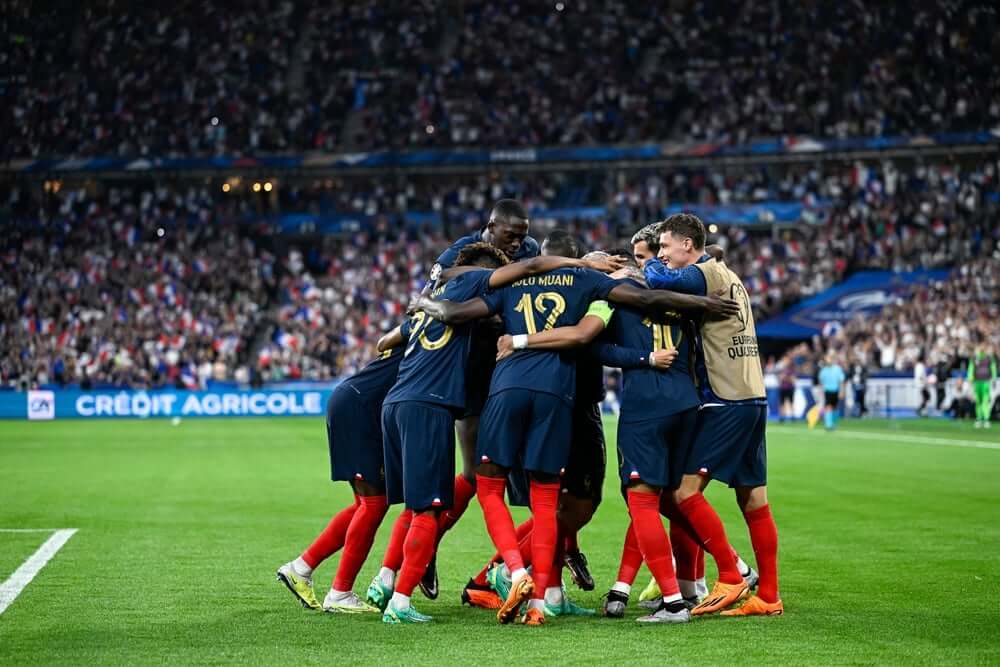
Didier Deschamps: The Coach Who Made Stars Into a Team
Deschamps’ coaching achievement at France is more impressive than the trophy count suggests at first glance. He has spent 14 years managing a squad of extraordinary individual talent – players whose club allegiances, playing styles, and personal ambitions could easily generate conflict and faction – and consistently forged them into a functional, almost unbeatable collective. That is a management achievement as much as a tactical one.
His most significant innovation has been building systems flexible enough to accommodate the evolution of his best players while maintaining structural reliability. The 4-2-3-1 he has used most frequently positions Mbappé as the central attacking threat – not a wide player who needs to be found with diagonal switches, but the focal point around whom the midfield and wide options create space and supporting runs. The double pivot of Aurélien Tchouaméni and Adrien Rabiot (or rotational alternatives) gives France the defensive insurance to allow their full backs to contribute offensively, while Dembélé, Olise, and Barcola provide constant rotation from wide positions that opposing full backs find almost impossible to manage for 90 minutes.
When games require different approaches, Deschamps is not ideologically rigid. He has deployed three-centre-back systems when protecting leads against pressing opponents, and he has shown willingness to shift tactically within a match when his first-half setup is not producing the expected results. That flexibility – rare among coaches who have been in position long enough to develop habits – is one of France’s genuine competitive advantages in a tournament that runs seven rounds over a month.
The depth of available talent – Deschamps can meaningfully vary his lineup across several positions without reducing quality – means France can absorb injuries, suspensions, and fatigue in a way that most other squads cannot. In a 32-team, seven-game competition where managing the squad across a month is as important as winning individual matches, France’s depth is a structural advantage that their title odds begin to price in but do not fully reflect.
France’s 2026 World Cup Squad: The Factory of Champions
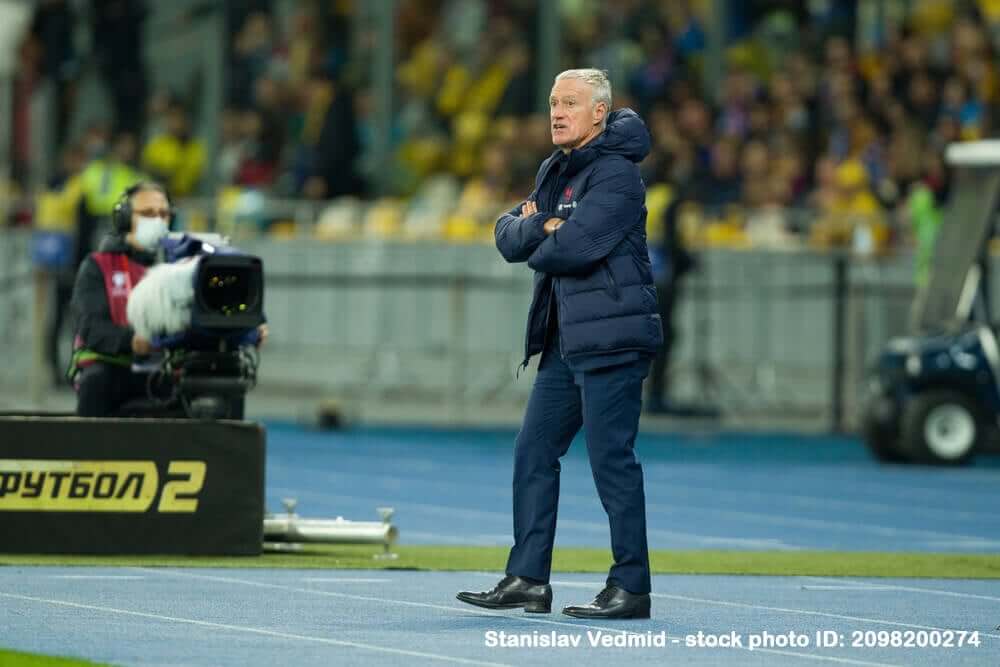
France’s projected starting lineup draws from some of the most significant clubs in world soccer, with depth options at every position that would start for most other national teams in this tournament.
| Position | Player | Club | Age (June 2026) |
| GK | Mike Maignan | AC Milan | 30 |
| RB | Jules Koundé | Barcelona | 27 |
| CB | William Saliba | Arsenal | 25 |
| CB | Dayot Upamecano | Bayern Munich | 27 |
| LB | Lucas Digne | Aston Villa | 32 |
| CDM | Aurélien Tchouaméni | Real Madrid | 26 |
| CM | Adrien Rabiot | AC Milan | 31 |
| RW | Ousmane Dembélé | PSG | 29 |
| AM | Michael Olise | Bayern Munich | 24 |
| LW | Bradley Barcola | PSG | 23 |
| ST | Kylian Mbappé | Real Madrid | 27 |
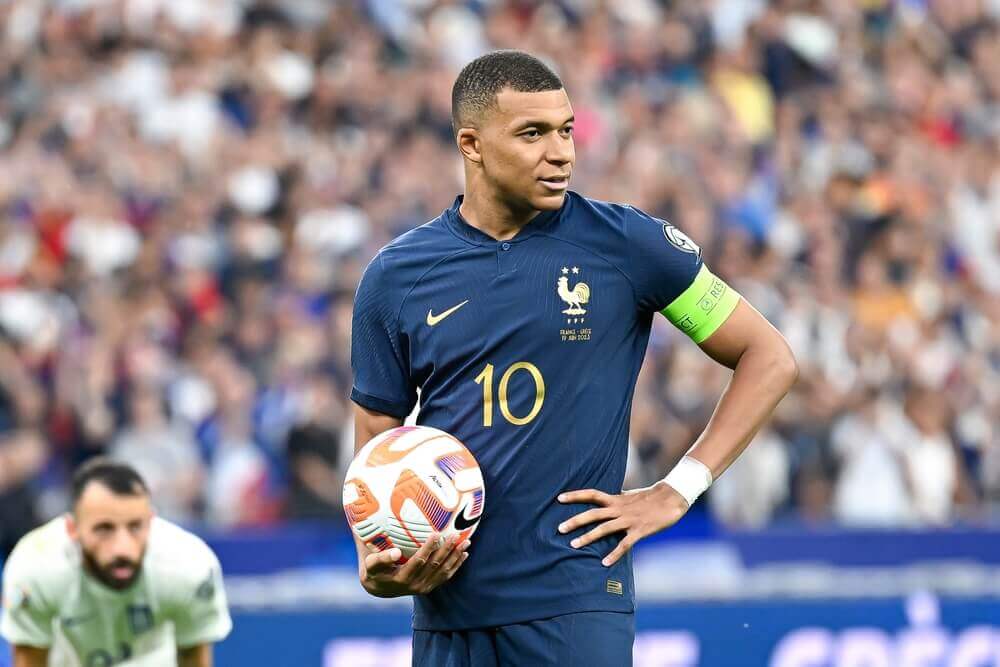
Kylian Mbappé – The Standard Bearer
Everything about Mbappé’s World Cup record demands the kind of reverence usually reserved for the retired legends of the game. At 27 years old at the 2026 tournament, he plays his third World Cup having already appeared in the finals of both previous editions: a title in Russia 2018 and a devastating runners-up finish after his hat-trick in the Qatar 2022 final was not quite enough. His 12 World Cup goals place him well on the path to surpassing Miroslav Klose’s all-time record of 16, and if France goes deep into the 2026 bracket, that record will face genuine threat.
As captain of Les Bleus, Mbappé has matured beyond the electric but sometimes unidirectional wide forward of his early international career. He now occupies the central striker role with the intelligence of a number nine who has studied the best, using movement, timing, and positioning to create chances as much as individual pace. At Real Madrid, competing for trophies against the world’s best defenders every week, he has developed the complete forward’s skill set. The 2026 World Cup is the stage where his legacy moves from “one of the greatest” to “the greatest of his era” – if France win it.
Warren Zaïre-Emery – The Youngest Voice in the Room
Zaïre-Emery made his senior France debut at 17 years, 8 months, and 10 days in a 14-0 victory over Gibraltar in 2023, scoring in that match and becoming the youngest goalscorer in Les Bleus history. Now a regular starter at PSG and firmly established in Deschamps’ squad rotation, the 19-year-old embodies the generation that will inherit this programme after the coach transitions to Zidane. His reading of the game at his age is extraordinary, and his capacity to both press and distribute from central midfield gives Deschamps a forward-thinking option in the double pivot that Tchouaméni and Rabiot do not provide.
Mike Maignan – The Goalkeeper Who Sets the Tone
Maignan replaced the legendary Hugo Lloris in the France goal and has exceeded expectations with performances that rank him among the top two or three goalkeepers in world soccer. His sweeping ability, distribution from the back, and shot-stopping in one-on-one situations give France a goalkeeper whose influence on Deschamps’ possession-based system extends well beyond the penalty area. The quality of the goalkeeper is often the decisive factor in knockout rounds; France’s is elite.
France’s Strengths and One Genuine Concern
Generational depth at every position. France can alter their starting lineup significantly without any meaningful drop in quality. Tchouaméni or Zaïre-Emery in midfield, Barcola or Thuram or Ekitike in attack, Camavinga or Rabiot covering different tactical needs – the options available to Deschamps represent a roster management advantage that compounds as the tournament progresses and accumulated fatigue becomes a factor.
Mbappé’s experience in the biggest moments. Most elite players need time to find their best form at a tournament. Mbappé has never not been decisive. His record in World Cup knockout rounds – goals against Argentina in the 2022 final, his entire 2018 tournament run – demonstrates a player who raises his level when the competition demands it most. That is not guaranteed, but it is a pattern worth enormous weight in any prediction model.
Tactical adaptability. Deschamps has shown across 14 years in charge that he can adjust his system based on what a specific opponent requires. He is not a coach who loses because his preferred system was exposed and he refused to change. France can be dominant with the ball or lethal in transition, and switching between modes within a match is something this squad executes as naturally as any team in the world.
Concern: The pressure of being the favourite. France has now lost three major tournament finals or semi-finals on penalties – including the 2022 World Cup final. Against Argentina, they were moments from winning and came up short. The psychological weight of that near-miss, combined with the expectation of being pre-tournament favourites, creates a pressure dynamic that Deschamps will need to manage carefully throughout the group stage and into the knockouts.
UEFA Qualifying: France’s Path to North America
France completed their UEFA qualifying campaign in dominant fashion, finishing first in their group across six matches against Ukraine, Iceland, and Azerbaijan. The table below reflects the completed standings.
| Pos | Team | GP | W | D | L | GD | Pts |
| 1 | France | 6 | 5 | 1 | 0 | +12 | 16 |
| 2 | Ukraine | 6 | 3 | 1 | 2 | -1 | 10 |
| 3 | Iceland | 6 | 2 | 1 | 3 | +2 | 7 |
| 4 | Azerbaijan | 6 | 0 | 1 | 5 | -13 | 1 |
The 16-point tally – five wins and a single draw from six matches – reflects a squad that treated qualifying as a professional obligation rather than a competitive challenge. Only Ukraine offered meaningful resistance, and France’s ability to manage those matches without exposing key players to unnecessary minutes proved how efficiently Deschamps handled the scheduling.
France’s World Cup History: A Record of Consistent Excellence
France has one of the most distinguished World Cup histories of the post-war era, built across decades of technical talent and, more recently, tactical organisation at the international level. Their inaugural major impact came at Sweden 1958, where the legendary Just Fontaine scored 13 goals in a single tournament – a record that still stands and may never be beaten. France fell in the semifinals on that occasion, as they did at España 1982 and México 1986 in two painful penalty shoot-out exits.
The culmination came in 1998, on home soil, when France hosted and won their first World Cup under Aimé Jacquet – Zidane’s brace against Brazil in the final securing a title that unified the country. Twenty years later at Russia 2018, Deschamps’ team won their second france world cup title, becoming the second nation to reach the title count that puts the france world cup wins tally at two. The most recent final – Qatar 2022, where Argentina edged them on penalties after one of the greatest games in tournament history – confirmed that even in defeat, France produces the most compelling football in the world when the stakes are highest.
From seven World Cups since 1998, France has contested the final four times. That record of consistent deep runs – including the two championships – is unmatched by any nation in the same period. It is the statistical foundation on which their 2026 title contention rests.
Ver esta publicación en Instagram
Group I: France, Senegal, Norway, Iraq
France’s Group I draw provided the kind of obstacle-free path that their seeding position warranted – no traditional powerhouse, no team capable of defeating Les Bleus on aggregate quality across 90 minutes, but enough individual danger in Senegal and Norway to demand complete focus in every fixture.
Senegal represent the AFCON-level quality that makes them one of the more difficult CONCACAF/CAF opponents France could have drawn. With Sadio Mané and a competitive collective structure, they will not be passive participants. Norway bring individual attack from Erling Haaland – whose World Cup debut will be one of the group stage’s most anticipated individual storylines – but defensive vulnerabilities that France will identify and exploit systematically. Iraq qualified through the intercontinental playoff, defeating Bolivia, and represent the most accessible Group I opponent for France’s firepower.
| Date | Time (ET) | Match | Venue |
| Tuesday, June 16 | 3:00 PM ET | France vs Senegal | New York/New Jersey Stadium |
| Tuesday, June 16 | 6:00 PM ET | Iraq vs Norway | Boston Stadium |
| Monday, June 22 | 5:00 PM ET | France vs Iraq | Philadelphia Stadium |
| Monday, June 22 | 8:00 PM ET | Norway vs Senegal | New York/New Jersey Stadium |
| Friday, June 26 | 3:00 PM ET | Norway vs France | Boston Stadium |
| Friday, June 26 | 3:00 PM ET | Senegal vs Iraq | Toronto Stadium |
All times are Eastern Time (ET). The Senegal and Norway matches will be shown on TSN and RDS across Canada.
Ver esta publicación en Instagram
France World Cup Odds and Our 2026 Predictions
France world cup odds at Canadian sportsbooks – including bet365, BetMGM, and FanDuel Canada – consistently position Les Bleus as a co-favourite or second favourite for the title alongside Argentina. Typical outright prices sit between 6.00 and 8.00, with market movements tracking injury news and tournament draw developments.
| Market | Approximate Odds |
| France to win the World Cup | 6.00 – 8.00 |
| France to advance from Group I | 1.05 – 1.10 |
| France to reach the final | 2.80 – 3.50 |
| France to win the final (outright) | 6.00 – 8.00 |
| Mbappé top scorer | 5.00 – 7.00 |
Odds are indicative and will change. Check current prices at your Canadian sportsbook.
The mbappe world cup 2026 individual goalscorer markets are among the tournament’s most liquid. His 12 existing World Cup goals, his likely six or seven matches if France goes deep, and his recent form at Real Madrid make him the most rational choice in the tournament top scorer market. At 5.00-7.00, it is not cheap, but it reflects genuine probability.
Can France win the World Cup in 2026? The analytical answer, backed by the evidence of the last 25 years and the current squad depth, is: they are one of two teams most likely to do so. Deschamps’ farewell tournament, Mbappé at the height of his powers, and a roster deep enough to absorb any single injury – the conditions are aligned as well as they have been since 2018. Our prediction: France advances from Group I with maximum or near-maximum points, reaches the semifinals without serious difficulty, and contests the final. Whether they win it depends entirely on whether the draw produces Argentina or Brazil as the opponent in the latter stages.
For complete World Cup 2026 analysis, full group breakdowns, and current World Cup 2026 odds across all Canadian sportsbooks, stay with BettingSite.ca. The France story in 2026 is one of the tournament’s essential narratives – Deschamps’ exit, Mbappé’s record hunt, and the pursuit of a third championship that would definitively answer the question of the greatest World Cup nation of the modern era.
France has been here before – in finals, in semifinals, in the most pressure-filled moments the sport produces. And more often than not, they have delivered. That is the foundation on which griezmann world cup 2026 coverage, Mbappé analysis, and every France betting market must ultimately rest. Les Bleus are not the favourites by accident.