If you have not followed soccer since Qatar 2022, the 2026 World Cup will feel fundamentally different from the tournament you remember. The world cup 2026 format is a complete structural overhaul: 48 teams instead of 32, 12 groups instead of 8, and a brand new Round of 32 that replaces the traditional Round of 16 as the first knockout stage. Understanding how does the world cup 2026 work — group stage advancement rules, the third-place qualification system, and the bracket structure — is essential both for following the competition and for identifying where the sharpest betting value lies across 104 matches over 39 days.
From 32 to 48 Teams: Why FIFA Made the Change
FIFA officially approved the expansion from 32 to 48 teams in 2017, with the 2026 tournament as the first implementation. The rationale was twofold: commercial and inclusionary. Adding 16 teams generates substantially more broadcast and hospitality revenue — the 2026 World Cup is projected to be the most financially successful in history. At the same time, expanding the field gives qualification opportunities to nations from confederations historically squeezed by a tight quota system.
The practical impact of the world cup 2026 new format is significant. Africa moves from 5 to 9 qualified teams. Asia from 4.5 to 8.5. CONCACAF from 3.5 to 6. This means previously excluded soccer nations now appear on the world stage. For Canada as a CONCACAF member, the expanded format was part of the reason Les Rouges qualified so comfortably — the pathway became wider.
Critics of the expansion raised concerns about group stage quality dilution — specifically, mismatches between elite nations and newly qualifying sides. FIFA’s counter-argument is that the group stage in a four-team group (where all teams play only three matches) is inherently competitive regardless of talent disparity, and the knockout rounds quickly eliminate the mismatch risk. For bettors, the expanded field means more handicap opportunities, more in-play value in group stage blowouts, and a longer tournament tail of elite knockout soccer.
The three-nation hosting arrangement — Canada, the United States, and Mexico — was itself partly a product of the expansion. A single nation could not realistically build enough world-class stadium infrastructure on short notice to host 104 matches. Spread across 16 venues and three countries already possessing NFL and MLB-grade facilities, the world cup 2026 format becomes practically executable.

Group Stage: 12 Groups of Four
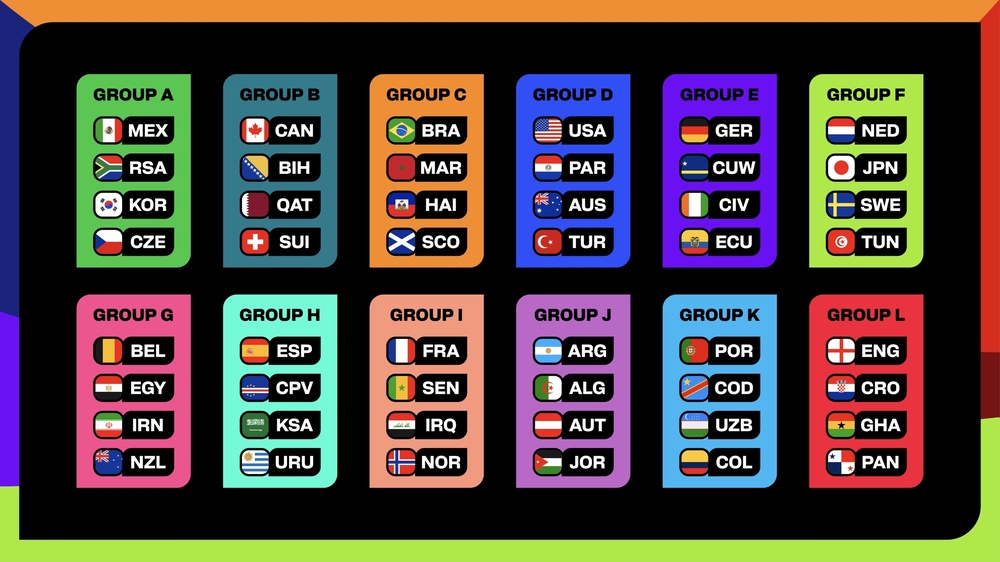
The world cup 2026 group stage divides 48 teams into 12 groups of four, labelled A through L. Within each group, the four teams play a round-robin: every team faces the other three once. That produces six matches per group, 72 group stage matches total across the tournament’s first 14 days.
Group standings are determined by points (3 for a win, 1 for a draw, 0 for a loss), then goal difference, then goals scored, then head-to-head record between tied teams, then disciplinary record (yellow and red cards), and finally FIFA World Ranking at the time of the draw. The same tiebreakers that applied in Qatar 2022 remain in place.
The final matchday of each group — Matchday 3 — features both group matches played simultaneously. This rule, borrowed from the existing World Cup format and introduced to prevent collusion, prevents a scenario where teams already knowing a result could play out an arrangement. All twelve group’s final rounds are played with simultaneous kick-offs within each group, though different groups may have their final matchdays on different calendar dates.
From each group, the top two teams advance automatically to the Round of 32. That accounts for 24 teams. The remaining 8 spots in the Round of 32 go to the best third-place teams from across the 12 groups — the world cup 2026 third place teams rule being the format’s most novel element. For Canada in World Cup 2026 Group B, the objective is clear: finish in the top two to guarantee advancement rather than relying on the third-place safety net.
The Best Third-Place Teams Rule
This is where the world cup 2026 format introduces its most interesting wrinkle. Twelve groups means twelve third-place finishers — teams that accumulate wins and points but do not finish in the top two of their group. Under the new rules, the 8 best of those 12 third-place teams advance to the Round of 32 alongside the group winners and runners-up.
Selection of the world cup 2026 best third place teams follows this priority order: most points accumulated across the group stage, then goal difference, then goals scored, then disciplinary record (fewest red and yellow cards), then FIFA ranking as the final tiebreaker. A third-place team with 6 points (two wins, one loss) is virtually guaranteed advancement. A third-place team with 3 points (one win, two losses) needs other results to fall their way.
The practical impact is that even a team suffering one early group stage defeat is not mathematically eliminated. Consider a scenario where Canada losses to Switzerland in the final group game but has already beaten Bosnia-Herzegovina and Qatar: Canada finishes third in Group B with 6 points, near certainly advancing as one of the best third-place teams. This safety net fundamentally changes the calculus of the final group stage matchday, reducing the catastrophic risk of a late stumble.
For the four third-place teams that do not advance, the tournament ends at the group stage despite potentially accumulating 4 or more points. This is the cruelest edge of the system — statistically, one or two third-place teams with solid records will go home while weaker group winners progress. It creates genuine tension on the final group stage days as fans simultaneously watch multiple groups to see how third-place positions shake out.
The world cup 2026 third place rule also affects the bracket. Pre-determined tables in FIFA’s regulations assign third-place qualifiers to specific positions in the Round of 32 bracket depending on which groups they emerge from. This means the bracket shape — and who the advancing teams face in Round of 32 — is locked in once groups are final.
Knockout Stage: The World Cup 2026 Bracket
Once the group stage concludes, the world cup 2026 knockout bracket takes over with 32 surviving teams. The structure is as follows:
Round of 32 (June 28 – July 2, 16 matches): The first-ever Round of 32 in World Cup history. All 32 teams play single-elimination matches. Win and advance; lose and go home. No more group stage safety nets. The world cup 2026 round of 32 is expected to produce multiple high-profile eliminations — major nations that historically coasted through an easier group-to-Round-of-16 path now face full-quality knockout opponents at the first hurdle.
Round of 16 (July 3 – July 6, 8 matches): The bracket reduces to sixteen teams, mirroring the format’s equivalent to the traditional World Cup’s quarterfinal entry point. Matches are spread across multiple venues. Rest periods between rounds ensure teams receive at least two days between fixtures.
Quarterfinals (July 9 – July 11, 4 matches): The elite eight. Venues confirmed include Gillette Stadium (Boston), SoFi Stadium (Los Angeles), Hard Rock Stadium (Miami), and Arrowhead Stadium (Kansas City) — four of the most iconic sports facilities in North America. At this stage, the world cup 2026 knockout bracket separates its two halves definitively, with the quarterfinal winners proceeding to one of two semifinals venues.
Semifinals (July 14 – July 15, 2 matches): AT&T Stadium in Arlington, Texas — one of the largest enclosed stadiums ever built — and Mercedes-Benz Stadium in Atlanta host the two semi-finals. Both venues have hosted marquee soccer events previously and are equipped for the spectacle. Third-place match: July 18 at Hard Rock Stadium, Miami. Final: July 19 at MetLife Stadium, East Rutherford, New Jersey.

Special Rules: Roster Size and Substitutions
The world cup 2026 format carries over two rule innovations that debuted at Qatar 2022 and have been confirmed to continue. First, the squad size: each nation names 26 players to their World Cup roster, up from the 23-player limit that applied from 1998 through 2018. The expanded roster gives coaches more tactical flexibility and injury coverage, particularly critical in a tournament stretching 39 days. The extra three spots are typically used for backup options at specialist positions — a second goalkeeper archetype, a set-piece specialist, or cover for a positionally unique player.
Second, the substitution rules continue the five-substitution model with one additional concussion substitution available per team per match — the so-called “5+1” structure. In standard play, each team may make five substitutions across three separate stoppages (plus half-time). The concussion sub is a sixth, unrelated change allowed specifically when a player is suspected of having suffered a head injury. Crucially, both teams are permitted a concussion sub even if one side triggered the allowance first, preventing cynical use of the rule to interrupt an opponent’s momentum.
A new time-management rule, confirmed by FIFA for 2026, also applies: substituted players must leave the field within 10 seconds of the substitution being indicated. If they exceed this limit, the incoming substitute must wait on the touchline for one full minute before entering, temporarily leaving their team with 10 players. This anti-time-wasting measure targets the slow walk to the tunnel that became a frustrating feature of high-pressure late-game situations. For more on this and other rule changes, see our full World Cup 2026 rules guide.
The 2026 Format in Context
The world cup 2026 format is the most ambitious restructuring of soccer’s premier tournament in almost three decades. It delivers more matches, more nations, and more moments of jeopardy than any previous edition. The expanded group stage produces 72 matches of competitive soccer before a single knockout ball is kicked. The Round of 32 adds a new layer of drama that eliminates the previous format’s tendency toward group stage dead rubbers. And the third-place rule keeps every team fighting until the final whistle of Matchday 3.
For Canadian fans, the format could not have arrived at a better moment. Canada enters as co-host, with a genuinely competitive roster, facing a manageable group, with the realistic possibility of advancing through the Round of 32 into the Round of 16 and beyond. The expanded world cup 2026 bracket gives Les Rouges not just one chance but potentially two or three to prove themselves on the greatest stage in sport. For complete format details and group analysis, visit our World Cup 2026 hub and the detailed groups guide.