Author: William Tremblay | Updated: 04.06.2026
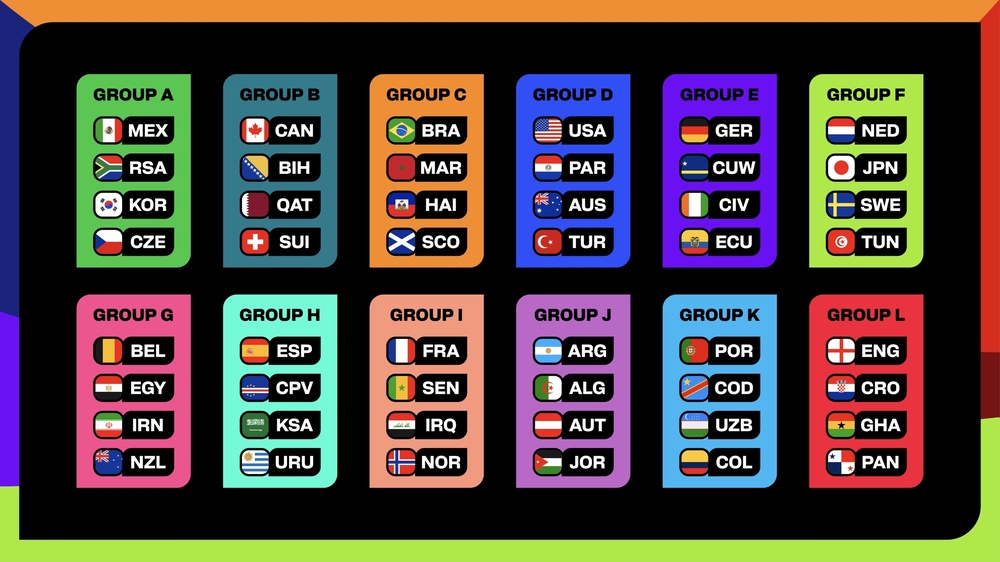
On December 5, 2025, at the John F. Kennedy Center for the Performing Arts in Washington, D.C., FIFA unveiled the world cup 2026 groups that will define the tournament’s first three weeks. Forty-eight teams across twelve groups — A through L — now know their path. The draw produced compelling storylines: a co-host nation (Canada) landing in a genuinely competitive group, a legitimate group of death in Group I, and several classic rivalries reignited. This guide covers every group, every team, and what the draw means for the group stage, with Canada’s Group B analysed in the depth Les Rouges fans deserve.
For the full tournament rundown see our complete World Cup 2026 guide, the team-by-team favourites breakdown, and live prices on our World Cup 2026 odds page.
How the Draw Works
FIFA structured the 2026 draw using four pots of twelve teams each. Pot 1 comprised the three host nations — Canada, the United States, and Mexico, pre-seeded as group toppers in Groups B, D, and A respectively — plus the nine highest-ranked non-host nations based on the October 2025 FIFA World Rankings. Pots 2, 3, and 4 filled the remaining spots in descending ranking order.
Geographic restrictions prevented teams from the same confederation from sharing a group, with one exception: UEFA’s qualified European nations could share groups given their volume, but no more than two per group. CONMEBOL teams were kept fully separate, ensuring Argentina, Brazil, Colombia, Uruguay and others cannot meet until the knockout rounds. The hosts were guaranteed to open at a home venue: Canada’s Group B Matchday 1 is at BMO Field in Toronto, the United States opens Group D at home, and Mexico’s Group A opener is the ceremonial first match of the tournament at Estadio Azteca on June 11. The draw also introduced a pre-set knockout bracket: where a team finishes in its group locks in its side of the Round of 32, creating real strategic stakes on the final group matchday.
Groups A to L
Group A: Mexico, South Korea, South Africa, Czechia
Mexico — despite a turbulent qualifying campaign — open their home World Cup at the legendary Estadio Azteca against South Africa on June 11. El Tri’s home advantage is enormous, and the Azteca generates an atmosphere few stadiums on earth can match. South Korea, powered by a generation featuring players from Europe’s top leagues, are the primary threat to a Mexican first-place finish. South Africa make a surprise return after hosting 2010, and Czechia, who came through the UEFA playoff, are the group’s unknown quantity. Mexico are heavy favourites to top the group.
Group B: Canada, Bosnia and Herzegovina, Qatar, Switzerland
This is the group that matters most to Canadian fans, and there is genuine reason for optimism. Canada drew one of the more favourable possible groupings for a co-hosting nation. For the full Group B breakdown, see the Canada section below.
Group C: Brazil, Morocco, Haiti, Scotland
Brazil arrive as one of the tournament’s heavyweights — five-time world champions who fell in the Qatar 2022 quarterfinals and have spent four years recalibrating. Morocco, who reached the semifinal in Qatar as the first African nation to do so under Walid Regragui, are the most significant threat. Scotland qualify for their first World Cup in decades and will relish the occasion, while Haiti, representing CONCACAF, face the steepest climb. Brazil are expected to top the group comfortably; the fight for second between Morocco and Scotland is one of the most intriguing sub-plots of the group stage.
Group D: United States, Paraguay, Australia, Türkiye
The United States, as host and perennial CONCACAF power, are heavy favourites to top Group D. The USMNT’s young core — built around its Premier League and Bundesliga generation — enters with genuine knockout-round ambitions. Paraguay, solid but unspectacular, are a manageable second-place challenger; Australia bring Socceroos resolve and the memory of their Qatar Round-of-16 run; and Türkiye, under Vincenzo Montella, offer technical quality and tactical flexibility. The hosts need to navigate cleanly to set up a favourable Round-of-32 position.
Group E: Germany, Ecuador, Ivory Coast, Curaçao
Germany’s much-publicized rebuild finally reaches the tournament stage. After the Qatar 2022 group-stage exit and a Euro 2024 quarterfinal on home soil, this is a must-deliver tournament for German soccer. Ecuador, one of CONMEBOL’s more consistent performers, will test Germany’s defensive solidity early; Ivory Coast bring African quality and pace; and Curaçao, in their first-ever World Cup, are the sentimental story of the group. Germany are expected to win it; the battle for second between Ecuador and Ivory Coast is a coin flip.
Group F: Netherlands, Japan, Tunisia, Sweden
The Netherlands, semi-finalists in Qatar 2022, bring an Eredivisie-seasoned core augmented by Xavi Simons’s matured Bundesliga form. Japan — who shocked Germany and Spain in Qatar — remain one of the most dangerous sides outside the traditional powers, with a high-press, disciplined style that dismantles unprepared opponents. Tunisia carry North Africa’s banner here, while Sweden’s return after missing both Russia 2018 and Qatar 2022 is a major story. This group is tighter than rankings suggest; Japan to finish second is a credible prediction.
Group G: Belgium, Egypt, Iran, New Zealand
Belgium’s golden generation has aged into a silver one, but the Red Devils remain competitive, and Romelu Lukaku’s fitness will be closely watched. Egypt, powered by Mohamed Salah potentially playing his last World Cup, are the group’s wildcard — his presence alone commands respect. Iran qualified through the AFC pathway and will defend compactly, and New Zealand, representing Oceania, complete a group where Belgium should top comfortably but second place is a three-way battle.
Group H: Spain, Uruguay, Saudi Arabia, Cabo Verde
Spain arrive as European and UEFA Nations League champions and one of the tournament’s most complete teams. La Roja’s possession game under a new generation — Pedri, Gavi and Lamine Yamal — makes them a pre-tournament favourite. Uruguay bring South American grit and Darwin Núñez at his physical peak; Saudi Arabia, who beat Argentina in Qatar, have built steadily; and Cabo Verde, in their first World Cup, bring Atlantic-island passion. Spain are near-certainties to top the group; Uruguay for second.
Group I: France, Senegal, Norway, Iraq
The group of death — discussed in detail in the section below.
Group J: Argentina, Algeria, Austria, Jordan
Argentina, the reigning world champions, are clear favourites to advance from Group J. Lionel Messi — confirmed by Scaloni as captain for a record sixth World Cup at 38 — is surrounded by a side still brimming with talent across Europe’s top clubs and Inter Miami. Algeria return for the first time since 2014 with a combative, experienced squad; Austria, under Ralf Rangnick’s high-intensity philosophy, are one of Europe’s most organized sides; and Jordan are the group’s surprise qualifiers. Argentina should win comfortably, with Austria the strongest bet for second.
Group K: Portugal, Colombia, Uzbekistan, Congo DR
Cristiano Ronaldo leads Portugal at a record sixth World Cup at 41, named captain in Roberto Martínez’s squad, with the late Diogo Jota honoured as a symbolic “plus one.” Portugal’s depth beyond Ronaldo has never been richer — Bruno Fernandes, Vitinha, Bernardo Silva, Rafael Leão and Pedro Neto give multiple attacking angles. Colombia, led by Luis Díaz, are CONMEBOL’s dark horses and qualified strongly; Uzbekistan (a debutant) and Congo DR are the wildcards, both capable of the organized defensive display that steals a point. Portugal are heavy favourites to top Group K.
Group L: England, Croatia, Ghana, Panama
England arrive at every World Cup as paper favourites and leave as cautionary tales. The 2026 edition may break the pattern: a young, cohesive squad under Thomas Tuchel, with Premier League depth across every position. Croatia — medalists in recent editions — are the most credible group-stage challenger, though their aging core needs youth. Ghana return after missing Qatar 2022, and Panama, through CONCACAF, will focus on resilience. England and Croatia top this group in some order; Ghana for a third-place push is the boldest prediction in Group L.
Canada in Group B: A Winnable Path
The Canada world cup group draw gave Les Rouges exactly what any co-host could reasonably ask for: competition that demands respect but does not inspire fear. Bosnia and Herzegovina, Qatar and Switzerland each present distinct challenges — but Canada, on home soil with a roster that reached the final round of CONCACAF qualifying, have the quality to advance.
The opening match against Bosnia and Herzegovina at BMO Field on June 12 (3:00 p.m. ET) sets the tone. Bosnia are technically disciplined and defensively organized; Canada must win this one, and a victory with the home crowd behind them sends a message to the tournament. Qatar are the group’s weakest link on paper — their 2022 World Cup as hosts was disastrous (three defeats, eliminated in the group) — and facing Canada at BC Place in Vancouver on June 18 (6:00 p.m. ET) is a steep ask, so Canada should collect maximum points. Switzerland — clinical, experienced and perennially underrated, with knockout-round finishes at the last four World Cups under Murat Yakin — are the genuine test; the June 24 clash at BC Place (3:00 p.m. ET) could decide top spot. If Canada beat Bosnia and Qatar, a draw against Switzerland suffices to advance.
Odds – Canada
19+ · Gambling can be addictive · Terms & Conditions apply · Odds are indicative
For deeper Canada analysis see our Canada World Cup 2026 squad & manager predictions and our take on whether Canada can win the World Cup.
Group of Death: Group I
Of all twelve world cup 2026 groups, Group I stands alone as the competition’s true group of death. Three elite programs — France, Senegal and Norway — are crammed into a single bracket with Iraq as the fourth participant. In a format where the top two from each group advance automatically plus the eight best third-placed teams, finishing third in Group I is still survivable — but none of France, Senegal or Norway will accept it.
France enter as one of the two or three best teams in the world. The 2018 champions and 2022 runners-up have refreshed their attack around Kylian Mbappé, while Aurélien Tchouaméni and Eduardo Camavinga anchor a midfield few can match. They have the resources to top the group without conceding, though group-stage inconsistency has bitten them before. Senegal’s blend of Premier League and Ligue 1 talent — Ismaïla Sarr, Pape Matar Sarr and others — creates problems for any defence, and a France vs. Senegal clash is among the most anticipated group fixtures of the tournament. Norway arrive on the back of Erling Haaland’s continued dominance; a single moment of his quality can change any match, and a first-place finish is their stated ambition. Iraq, through the AFC pathway, face the sternest assignment — a single point would be a landmark. The realistic read: France top, then a Senegal vs. Norway battle for second, with the loser still likely advancing as a best third-placed team.
Full Group Stage Table
| Group | Pot 1 (Host/Top Seed) | Pot 2 | Pot 3 | Pot 4 |
| A | Mexico | South Korea | South Africa | Czechia |
| B | Canada | Bosnia and Herzegovina | Qatar | Switzerland |
| C | Brazil | Morocco | Haiti | Scotland |
| D | USA | Paraguay | Australia | Türkiye |
| E | Germany | Ecuador | Ivory Coast | Curaçao |
| F | Netherlands | Japan | Tunisia | Sweden |
| G | Belgium | Egypt | Iran | New Zealand |
| H | Spain | Uruguay | Saudi Arabia | Cabo Verde |
| I | France | Senegal | Norway | Iraq |
| J | Argentina | Algeria | Austria | Jordan |
| K | Portugal | Colombia | Uzbekistan | Congo DR |
| L | England | Croatia | Ghana | Panama |
The Bracket Stakes: Why Group Position Matters More Than Ever
Under the new format, the eight best third-placed teams across the twelve groups advance to the Round of 32 alongside all group winners and runners-up. Third-place selection is based on points first, then goal difference, goals scored, discipline record and FIFA ranking. Critically, the bracket is pre-set: a team finishing third in Group B lands in a different part of the draw than a third-placed team from Group F. Finishing first versus second therefore doesn’t just carry moral value — it determines your Round-of-32 opponent and your path toward the final.
For Canada, topping Group B would be the optimal outcome, since group winners earn potentially more favourable second-round matchups. The group standings will be followed obsessively in Canada from the June 12 opener through the simultaneous June 24 finales. Start at our World Cup 2026 hub for updated odds and analysis, and see our match-by-match predictions & tips throughout the group stage.
Fixture times and details valid as of 04.06.2026 and subject to change. Sports betting can be addictive. Please bet responsibly and only what you can afford to lose. 19+ in most provinces (18+ in Alberta, Manitoba and Quebec). If gambling stops being fun, support is available through ConnexOntario and provincial responsible-gambling services.