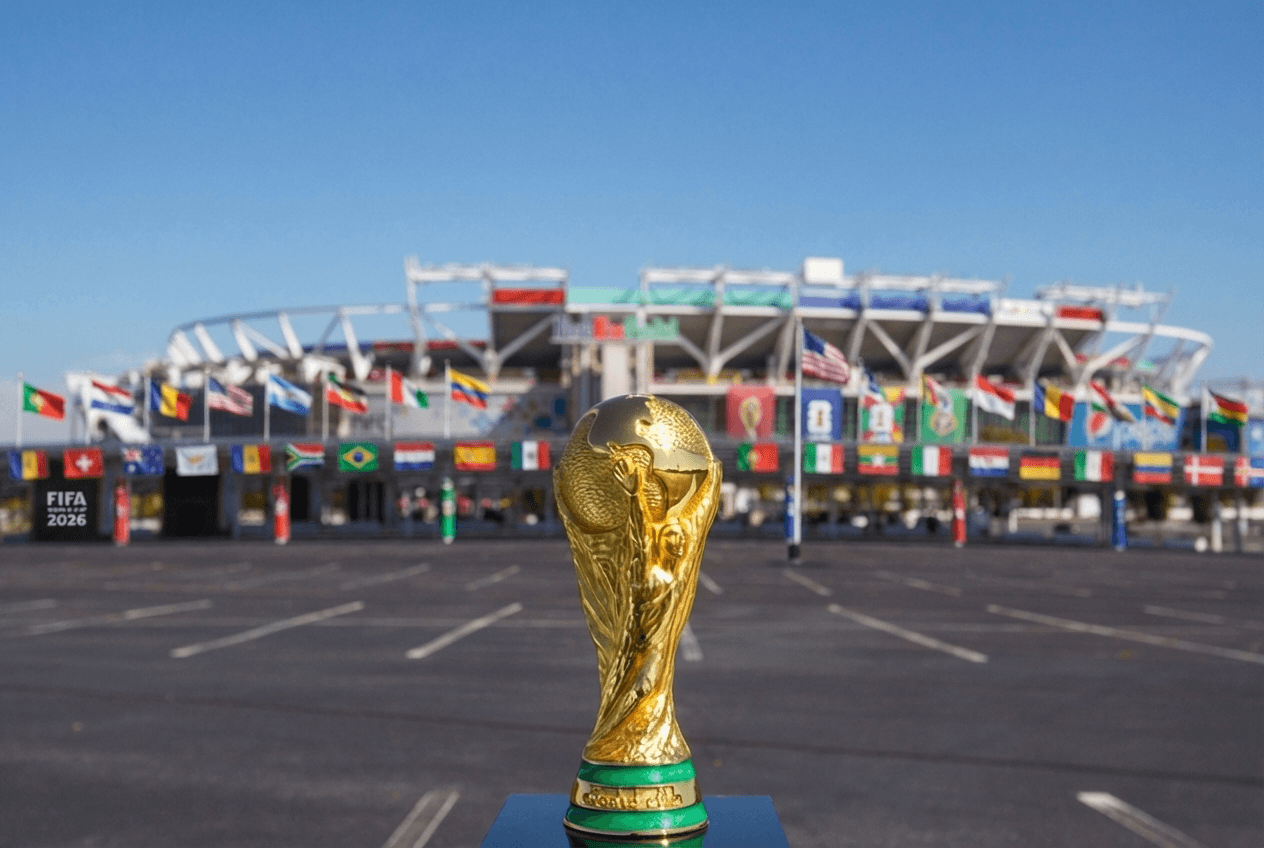
Hosting a FIFA World Cup is the most operationally complex undertaking in global sport. The 2026 edition raises that bar further: three co-hosting nations, 16 cities across two time zones and two languages, 48 competing teams, 104 matches, and an estimated 6 million attendees – the largest World Cup in the tournament’s history. For fans planning to attend and for bettors tracking how organizational factors shape match conditions and markets, understanding the security architecture and logistical framework of this event is not background reading. It’s essential context.
Tournament Organization: An Unprecedented Tri-National Undertaking
The 2026 World Cup is the first in history jointly hosted by three sovereign nations. Canada, the United States, and Mexico each bring their own legal frameworks, law enforcement agencies, transportation infrastructure, and crowd management traditions to a tournament that must function as a seamless whole. FIFA has worked closely with each host’s organizing committee – Canada Soccer’s organizing arm, the U.S. Soccer Federation’s local organizing committee, and the FMF in Mexico – to establish unified standards across all 16 venues.
The logistical challenge is staggering. Over the 39-day tournament, teams, officials, and fans will move between cities across two countries with land borders that FIFA has designated as special transit corridors for credentialed participants. Cross-border movement between Canada and the United States – and between the U.S. and Mexico – has been streamlined through special accreditation systems that allow credentialed World Cup participants to transit with expedited border processing. Fans without credentials must still follow standard immigration procedures, which means Canadians attending matches in Dallas and then crossing to Monterrey need valid passports and appropriate documentation for Mexico.
FIFA’s central organizing body is headquartered in New York for the duration of the tournament, with satellite operations offices in each host country. The World Cup Village concept – dedicated infrastructure hubs near each stadium for team training, media, and administrative operations – has been replicated across all 16 host cities, representing a logistical investment that runs into the billions of dollars across public and private sources.

Security Measures Across the Three Host Countries
Security planning for this World Cup is the most extensive in the tournament’s history, drawing on lessons from Qatar 2022, Russia 2018, and Brazil 2014, as well as from large-scale domestic events like the Super Bowl, the Olympics, and major political conventions hosted in North American cities.
At the stadium level, all 16 venues have established a standardized outer perimeter – a 2.5-metre fence set well back from stadium entrances – that creates a controlled buffer zone between the general public and the match environment. Fans pass through multiple screening layers before reaching their seats: bag checks, metal detectors, and in several venues, AI-assisted surveillance cameras capable of real-time crowd behaviour analysis and facial recognition protocols for flagged individuals on security watchlists.
The Federal Aviation Administration (FAA) in the United States has formally designated all American World Cup stadiums and their surrounding airspace as No Drone Zones on match days, with Temporary Flight Restrictions applying to broad radius areas around each venue. Similar restrictions are being implemented by Transport Canada around BMO Field and BC Place on match days. These measures address the growing security concern posed by commercially available drone technology near large crowd gatherings.
City-level coordination varies in specificity but follows a unified command model at each host city. Seattle’s published plan, one of the most detailed released by any host city, involves a unified command structure led by police, fire, transportation, and emergency management departments, with over 40 cooperating agencies – municipal, state, and federal – activated on each match day. Dedicated staffing in fan zones, alternative emergency response units designed to navigate crowd-dense areas, and major street closures and parking restrictions around Lumen Field on match days are all part of the operational blueprint.
In Canada, the RCMP works alongside Toronto Police Service and Vancouver Police Department in their respective cities, with the Canadian Security Intelligence Service (CSIS) providing threat assessment and intelligence coordination. Both BMO Field and BC Place have been assessed and cleared under FIFA’s stadium safety standards, and local transit agencies – the TTC in Toronto and TransLink in Vancouver – have published enhanced service plans for match days to manage the surge in ridership.
Mexico’s security arrangements involve the Guardia Nacional (National Guard) alongside state and municipal police forces in Mexico City, Guadalajara, and Monterrey. The Azteca has hosted major international events for decades and carries extensive institutional experience in crowd management. Monterrey, with its history of club soccer passion and North American business culture, has implemented additional surveillance infrastructure in the areas surrounding Estadio BBVA.
Ver esta publicación en Instagram
Potential Risks and Challenges
No security plan for an event of this scale operates without risk, and informed analysis requires acknowledging the challenges as clearly as the preparations designed to address them.
The tri-national format creates coordination seams that do not exist at single-nation World Cups. When a team travels from a Mexican venue to an American one – or from Canada to the United States for a knockout match – the jurisdictional handover between security agencies requires meticulous planning and real-time communication protocols. Any disruption to those handovers, whether from a political incident, a labour dispute, or an unforeseen security event, has the potential to cascade into match scheduling and logistics in ways that tournament organizers at single-nation events don’t face.
Civil disorder is another consideration that analysts have flagged, particularly around politically charged matches. The 2026 World Cup takes place against a backdrop of geopolitical tensions that could manifest in fan confrontations, protests near venues, or politically motivated disruptions. FIFA and host governments have developed protocols for these scenarios, including the ability to restrict ticket sales for specific matches, deploy additional public order resources, and coordinate with foreign government security personnel traveling with high-risk national teams.
Cyberattacks targeting ticketing systems, broadcast infrastructure, and payment platforms represent the most technically sophisticated risk profile for an event of this scale. FIFA and its technology partners have invested heavily in cybersecurity hardening, but the threat is not negligible – attacks on the 2018 Russia World Cup’s infrastructure, though largely contained, established a precedent for adversarial interest in the tournament’s digital systems.
Weather-related disruptions are a smaller but real concern. Venues in the Gulf Coast region – Miami and Houston – sit within hurricane season, which runs from June through November. While statistically unlikely to affect the tournament directly, extreme weather events such as tropical storms, lightning delays, and severe heat advisories could affect match scheduling and fan safety protocols at vulnerable venues.
Transportation and Logistics for Fans
Getting to matches is one of the most consistent pain points for fans at large-scale sporting events, and FIFA has invested significant effort in coordinating transportation plans with each host city. The general principle is to maximize transit and pedestrian access while restricting private vehicle use close to stadiums on match days.
In Toronto, the TTC and GO Transit have published enhanced service schedules for BMO Field match days. The stadium sits adjacent to Exhibition GO Station, making it accessible by rail from much of the Greater Toronto Area. The 509 and 511 streetcar lines also serve the venue directly. Additional shuttle services from Union Station are expected on Canada’s match days.
In Vancouver, the Canada Line SkyTrain provides direct connection from YVR airport to downtown Vancouver in under 30 minutes, and stadium-adjacent bus routes connect to BC Place. The city’s cycling infrastructure is also among the best in North America – a surprisingly viable option for fans staying in the downtown core.
Cross-border travel between host cities requires air transport for most fans – the distances between American cities are significant, and bus or rail travel is impractical for inter-city tournament-hopping. American airports in host cities have published enhanced operational plans for the World Cup period, with extended security staffing and increased gate capacity for international arrivals.
For fans considering multi-city itineraries – Toronto to New York to Miami, for example – domestic flights in the United States are efficient and competitively priced when booked in advance, though match-week demand will push prices significantly. Package deals through FIFA’s official travel and hospitality partners include accommodation and transportation bundles that can be more cost-effective than piecing trips together independently.
How Security and Organization Affect Betting Markets
The relationship between tournament organization and betting markets is indirect but real. Security disruptions, match delays, or venue changes can affect not just the match in question but the broader tournament odds – particularly in live-betting markets where real-time conditions drive pricing.
For pre-match betting, the most relevant organizational consideration is the consistency of match conditions across venues. Teams that have scouted and trained for a specific playing surface, altitude level, or stadium environment will have minor preparation edges that organized touring parties can leverage. Teams that arrive to find their expected training ground unavailable, or whose pre-tournament logistics have been disrupted by security protocols or travel delays, will show measurable form degradation in the opening group-stage matches – an effect that is well-documented from previous World Cups.
Canada, as a co-host with home matches at familiar BMO Field, benefits from an organizational stability edge in the group stage. Jesse Marsch’s squad will train on familiar turf, deal with no time zone disruption, and face no travel fatigue in the opening rounds. That organizational advantage – often overlooked in favour of purely tactical analysis – is worth factoring into Les Rouges’ early-tournament prices at sportsbooks. For complete World Cup 2026 odds analysis and market breakdowns, visit our World Cup betting guide and odds hub.