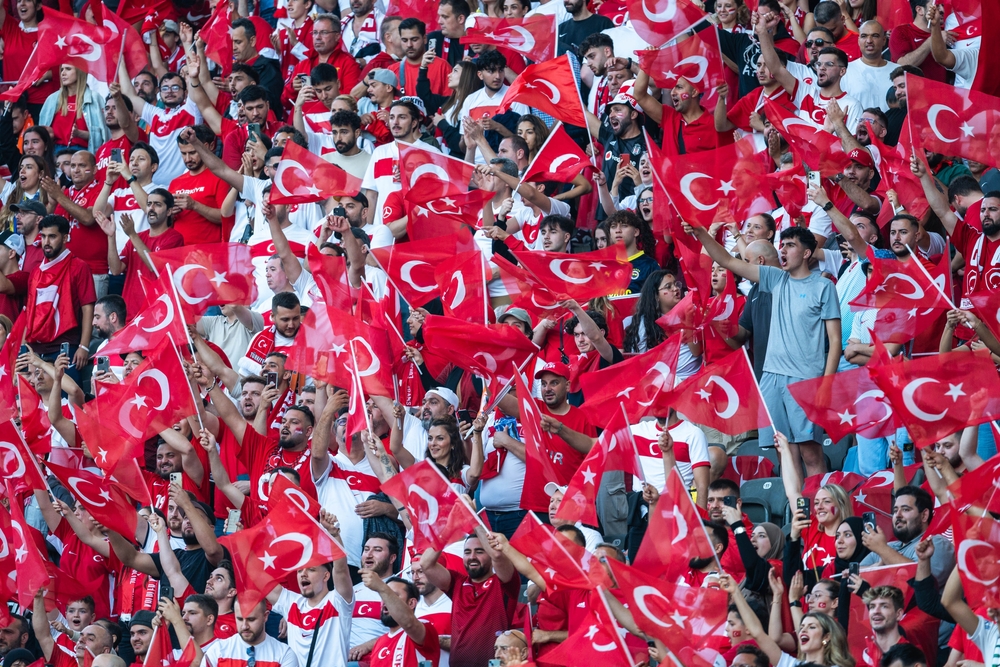
After a 24-year absence from the world’s biggest stage, Turkey is back. The Crescent Stars – coached by Vincenzo Montella – navigated a roller-coaster UEFA qualifying campaign and a tense two-leg playoff to punch their ticket to the 2026 FIFA World Cup in Canada, the United States, and Mexico. For Turkey World Cup 2026 is not just a return; it is a statement. With Real Madrid creator Arda Güler, Juventus playmaker Kenan Yıldız, and Inter Milan captain Hakan Çalhanoğlu, this may be the most technically gifted Turkish roster since the legendary side that finished third in Korea-Japan in 2002.
Turkey’s Road to the 2026 World Cup
Turkey’s qualification came in two distinct phases. In UEFA’s regular group stage, Montella’s side was drawn into Group E alongside Spain, Georgia, and Bulgaria. Turkey swept the board against the weaker opposition – winning all four matches against Georgia and Bulgaria with a commanding combined goal difference – but suffered a humbling 6-0 defeat to Spain in one of their two meetings with the European champions. That result dropped Turkey to second place and sent them into the UEFA playoff bracket.
Rather than collapsing under the weight of that loss, the squad regrouped with the composure of a team that knows how to win matches that matter. In the playoff semifinal on March 26 at Istanbul’s Tüpraş Stadium, Turkey faced Romania in a tightly contested game decided by a single moment of brilliance: a perfectly weighted Arda Güler assist threading through Romania’s defensive block for the game’s only goal. Turkey won 1-0.
The playoff final on March 31 in Pristina pitted Turkey against a combative Kosovo side with genuine European ambitions. It followed the same script: a physically demanding, chance-scarce contest decided by one goal. In the 53rd minute, Orkun Kökçü found Kerem Aktürkoğlu with a precise pass; the Galatasaray winger finished at close range to seal a 1-0 victory and Turkey’s first World Cup berth since 2002.
“It’s been 24 years,” said Aktürkoğlu after the final whistle. “The majority of us don’t even remember 2002. Now we’ll make our younger brothers dream about 2026 too.”
Ver esta publicación en Instagram
Coach Vincenzo Montella and Turkey’s Tactical Identity
Vincenzo Montella arrived as Turkey head coach in September 2023, replacing Ştefan Kuntz, and quickly established a tactical framework that balances European sophistication with the directness that defines the Turkish national identity at its best.
The Italian, who built his reputation at Fiorentina and Sevilla as an inventive, possession-minded coach, operates predominantly in a 4-2-3-1 or 4-3-3 system. Double pivots in midfield protect the back four while giving his attacking trio – Güler, Yıldız, and Çalhanoğlu – freedom to combine and interchange in the spaces between opposition lines. Pressing is high but selective: Turkey doesn’t commit to relentless gegenpressing, instead pressing in triggered moments – usually when the opposition goalkeeper or center-backs receive under pressure – and retreating into a disciplined mid-block when possession is lost in dangerous areas.
Montella has been explicit about wanting to control matches through midfield rather than absorbing pressure and hitting on the counter, though the playoff results against Romania and Kosovo demonstrated that his side can also win ugly when required – a quality that separates good tournament sides from great ones. Both victories required Turkey to hold a single-goal lead through periods of sustained opponent pressure. They did so without conceding.
Set pieces represent an area of noticeable improvement under Montella. Güler and Kökçü are both capable of delivering pinpoint crosses and free kicks, and Turkey’s delivery and movement from dead balls developed markedly through the qualifying campaign. In the compact tactical battles expected in Group D, dead-ball situations may prove decisive.
One tactical question for the tournament is how Montella manages the balance between Güler’s creative freedom and the defensive responsibilities that come with Turkey’s press-and-block system. In qualifying, the 20-year-old was occasionally substituted at halftime of tight games to deploy more defensive-minded options. At the World Cup, making those calculations correctly – when to protect Güler and when to unleash him – could define Turkey’s tournament.
Turkey’s World Cup 2026 Squad and Key Players
Turkey arrives in 2026 with arguably their most technically accomplished squad since the 2002 generation. Four players carry the primary weight of expectation.
Arda Güler – Real Madrid
At 20 years old, Güler has already cemented himself as one of Europe’s most exciting creative midfielders. His debut Champions League seasons at Real Madrid demonstrated a technical maturity that belies his age – precision passing in congested spaces, the ability to shift a match’s tempo with a single dribble, and a footballing intelligence that locates openings before they fully form. His assist in the playoff semifinal against Romania was quintessential Güler: unhurried, precise, completely decisive.
Kenan Yıldız – Juventus
Another player under 22 operating at Champions League level, Yıldız finished the qualifying campaign with three goals and has been in exceptional form for Juventus. He occupies the left channel or plays as a second striker, and his direct running at defenders generates the overloads Turkey need to unlock structured defensive systems. His individual quality in one-vs-one situations gives Montella a different kind of threat to Güler’s combination play.
Hakan Çalhanoğlu – Inter Milan, Captain
The heartbeat of both Inter and Turkey, Çalhanoğlu reads the game from deep midfield with a rare blend of passing range, late-arriving runs into the box, and genuine leadership. As captain, he sets tempo and tone. His partnership with Güler in central areas is Turkey’s primary creative axis, and in big tournament moments – penalty situations included – his composure has been proven repeatedly at the highest level.
Kerem Aktürkoğlu – Galatasaray
The hero of the Kosovo playoff final, Aktürkoğlu is a high-energy, direct winger with pace and a nose for goal. Operating on the right in Montella’s system, he’s dangerous cutting inside on his left foot and equally effective delivering from wide positions. His combination with Kökçü down the right flank gave Turkey consistent width and penetration through qualifying.
Supporting the starting four are goalkeeper Altay Bayındır (Manchester United), right back Zeki Çelik (Roma), and the deeper Orkun Kökçü (Benfica) – a roster with genuine depth and Premier League-level experience spread throughout positions.
Ver esta publicación en Instagram
Turkey’s Strengths and Weaknesses at World Cup 2026
Turkey’s most compelling strength is the quality and density in their creative midfield. In Güler, Yıldız, and Çalhanoğlu, Montella possesses three legitimate match-winners capable of breaking down any defence in the world on their day. Very few sides at the 2026 tournament can match that creative concentration in the centre of the pitch – and Group D, notably, features no current top-10 European side.
Resilience under pressure is the second asset. Both playoff wins were gritty, low-scoring affairs decided by single moments of quality. A team that can grind out results like that in high-pressure knockout scenarios is dangerous in any elimination bracket.
The most vulnerable area is the defensive line at pace. Turkey’s high defensive shape can be exposed by quick, direct forwards – Australia’s attack, Paraguay’s mobile strikers, and above all USA’s athletic build-up play all represent potential mismatches against Turkey’s back four. The 6-0 loss to Spain – against the world’s number-one team, admittedly – exposed the central defensive pairing’s susceptibility to rapid combination play in tight spaces.
Squad depth is also a concern beyond the starting eleven. Turkey’s quality drops noticeably when core players are unavailable, which means injury management across a physically demanding three-match group stage in North American summer heat will be a critical variable.
Turkey’s UEFA World Cup 2026 Qualifying Results
Turkey qualified through UEFA Group E, finishing second behind Spain before advancing through the playoff bracket.
| Pos | Team | P | W | D | L | GD | Pts |
| 1 | Spain | 8 | 7 | 1 | 0 | +22 | 22 |
| 2 | Turkey | 8 | 5 | 0 | 3 | +7 | 15 |
| 3 | Georgia | 8 | 2 | 1 | 5 | -8 | 7 |
| 4 | Bulgaria | 8 | 1 | 0 | 7 | -21 | 3 |
Note: Group standings are final tallies based on reference data. Turkey’s three losses include the 6-0 defeat to Spain.
UEFA Playoff path: Semifinal (March 26, Tüpraş Stadium, Istanbul) – Turkey 1-0 Romania. Final (March 31, Pristina) – Turkey 1-0 Kosovo.
Turkey’s World Cup History
Turkey’s FIFA World Cup record is brief but contains one of the competition’s most memorable achievements. Their debut came in 1954 at the inaugural tournament in Switzerland, where they were eliminated in the group stage. A 48-year gap followed before Şenol Güneş’s remarkable 2002 side defied expectations to finish third in Korea-Japan – defeating South Korea in the third-place match with a team built around goalkeeper Rüştü Reçber, striker İlhan Mansız, and the tactical intelligence of a generation who had grown up playing in European club football.
That 2002 run remains the benchmark for Turkish soccer internationally. In the two decades since, Turkey regularly competed at European Championships – reaching the Euro 2008 semifinal before losing to Germany – but could never recapture the World Cup momentum, missing qualification in 2006, 2010, 2014, 2018, and 2022. For a generation of Turkish players and supporters who heard about 2002 but never experienced a World Cup themselves, the 2026 tournament is simultaneously a reunion with history and a chance to build new memories from scratch.
| First Appearance | 1954 |
| Total Appearances | 3 (1954, 2002, 2026) |
| Best Result | Third Place (2002) |
Turkey’s Group D Fixtures at World Cup 2026
Turkey has been drawn into Group D alongside the United States (co-hosts), Paraguay, and Australia. The draw is competitive but navigable – no current top-10 European side, and no South American giant. Turkey’s path to the Round of 32 runs through beating Australia or Paraguay, while a result against USA would position the Crescent Stars strongly at the top of the group.
| Team | FIFA Ranking | Confederation |
| USA | 16 | CONCACAF (Co-Host) |
| Australia | 23 | AFC |
| Turkey | 25 | UEFA |
| Paraguay | 63 | CONMEBOL |
| Date | Match | Venue | Kickoff ET | Kickoff PT |
| Sat, June 13 | Australia vs Turkey | BC Place, Vancouver, Canada | 12:00 PM | 9:00 AM |
| Thu, June 19 | Turkey vs Paraguay | Levi’s Stadium, Santa Clara | 12:00 PM | 9:00 AM |
| Wed, June 25 | Turkey vs USA | SoFi Stadium, Los Angeles | 10:00 AM | 7:00 AM |
The opening match against Australia in Vancouver on June 13 at BC Place gives Turkey a favorable start – Australia’s ranking reflects quality but also an AFC side Turkey should expect to handle. The June 25 clash against USA at SoFi Stadium in Los Angeles is the group’s marquee fixture. Turkey defeated the Americans 2-1 in a 2025 friendly, and that psychological edge will not be lost on either coaching staff heading into a potentially decisive finale. For complete analysis of the group, see our World Cup 2026 groups breakdown.
Ver esta publicación en Instagram
Turkey World Cup 2026 Odds and Predictions
Turkey’s position in betting markets reflects genuine optimism around the squad’s quality and the favorable group draw. At Canadian sportsbooks, the Crescent Stars are positioned in the second tier of contenders – not among the title favourites, but well clear of the longshots.
Data aggregated from prediction markets Polymarket and Kalshi heading into the tournament shows a striking result for Group D probability:
| Team | Probability to Win Group D |
| USA (Co-Host) | 40% |
| Turkey | 39.5% |
| Paraguay | 19.5% |
| Australia | 5.5% |
Turkey’s 39.5% probability of topping the group – essentially matching USA despite the Americans’ co-hosting advantage – reflects several analytical factors: the depth of Turkey’s offensive midfield, their effectiveness in high-pressure playoff scenarios, and a draw that contains no current top-10 European nation. Analysts also point to Turkey’s single qualifying defeat being against Spain, the world’s number-one ranked team, as a sign the result was an outlier rather than a structural vulnerability.
For tournament outright odds, Turkey are positioned mid-table alongside Denmark and Austria – realistic contenders for a deep knockout run if the Güler-Yıldız-Çalhanoğlu axis fires at full capacity. Check our World Cup 2026 odds page for the latest lines across all Canadian sportsbooks, and visit the World Cup 2026 hub for complete tournament coverage.
Turkey’s return to the World Cup is long overdue – but the timing may be perfect. A roster of this technical quality, in a manageable group, with the experience of a proven European coach and the hunger of a nation waiting 24 years for this moment: that is a combination worth watching very closely.