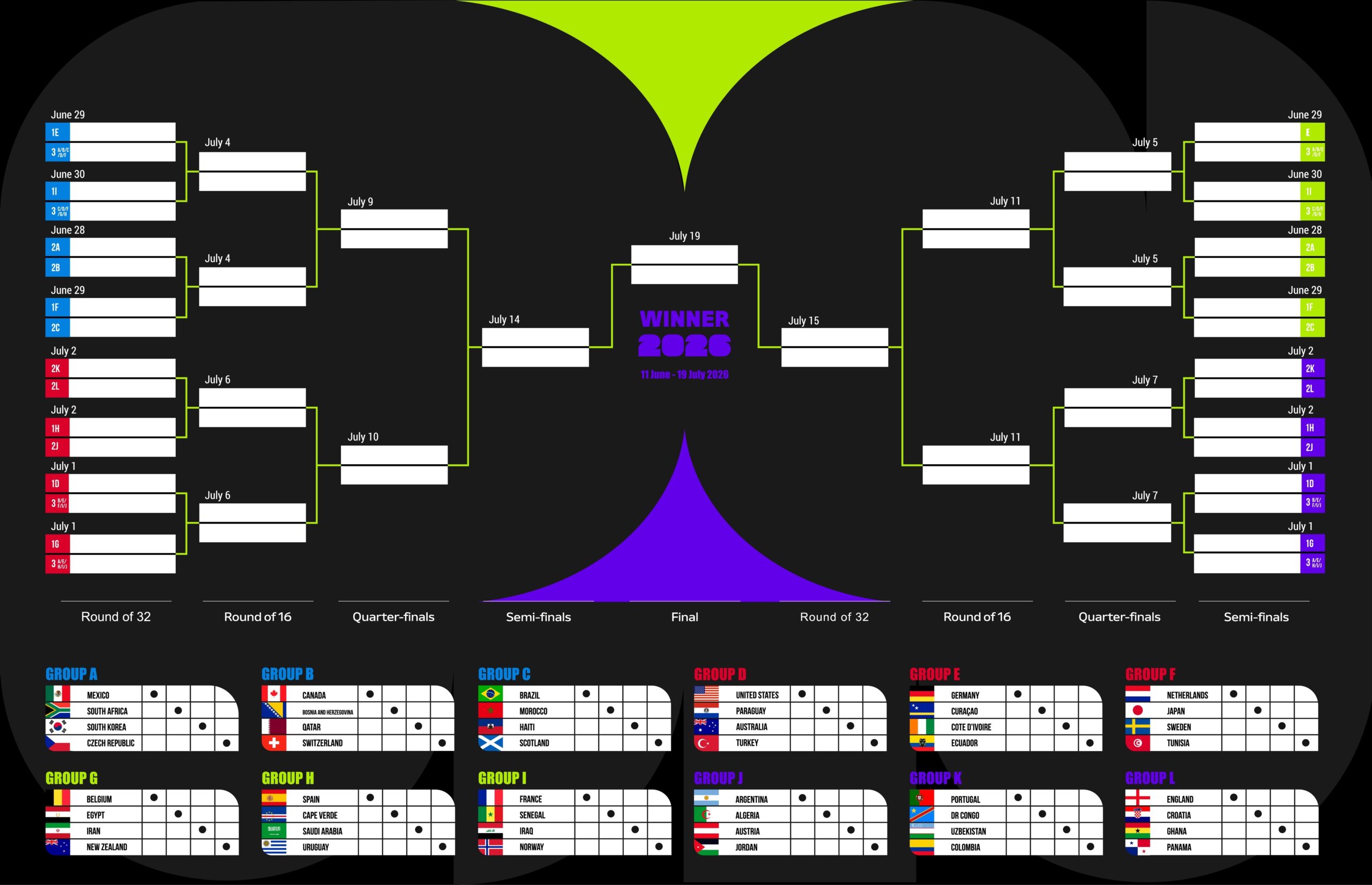
World Cup 2026 Bracket – A championship isn’t just won – it’s navigated. The difference between winning a World Cup and exiting before the semi-finals often comes down to bracket luck as much as talent: which side of the draw you land on, which potential opponents you avoid until the final, and whether the team you meet in the Round of 32 happens to be peaking at the exact wrong moment for you. With 48 nations competing in 2026 across the most geographically expansive tournament in the event’s history, the world cup 2026 prediction game becomes both more complex and more analytically interesting than at any previous edition. Here’s a framework for thinking through the bracket – and the markets it creates.
How the World Cup 2026 Bracket works: Architecture of a Champion’s Path
World Cup 2026 runs 48 teams through 12 groups of four. The top two finishers from each group advance automatically; the eight best third-place finishers from across all 12 groups complete the 32-team knockout field. Those 32 teams are then slotted into a predetermined bracket based on group positions established at the tournament draw – meaning the potential matchups in the Round of 32 are set before the first ball is kicked.
FIFA’s seeding system for the group draw separates the 12 highest-ranked nations into separate groups, ensuring they cannot meet until the knockout rounds. In practice, this means the tournament’s top-ranked nations – France, Brazil, England, Spain, Argentina, Germany, Portugal, and the three co-hosts (Canada, USA, Mexico) – will each anchor their own group. The bracket is then constructed so that first-place finishers from certain groups meet third-place qualifiers from other groups in the Round of 32, while group runners-up face other runners-up.
A team must win seven consecutive matches to lift the trophy: three group games, then Round of 32, Round of 16, quarter-final, semi-final, and final. The minimum path hasn’t changed from the 32-team format, but the opponents along that path – and the physical cost of navigating five weeks of tournament competition – have shifted significantly.
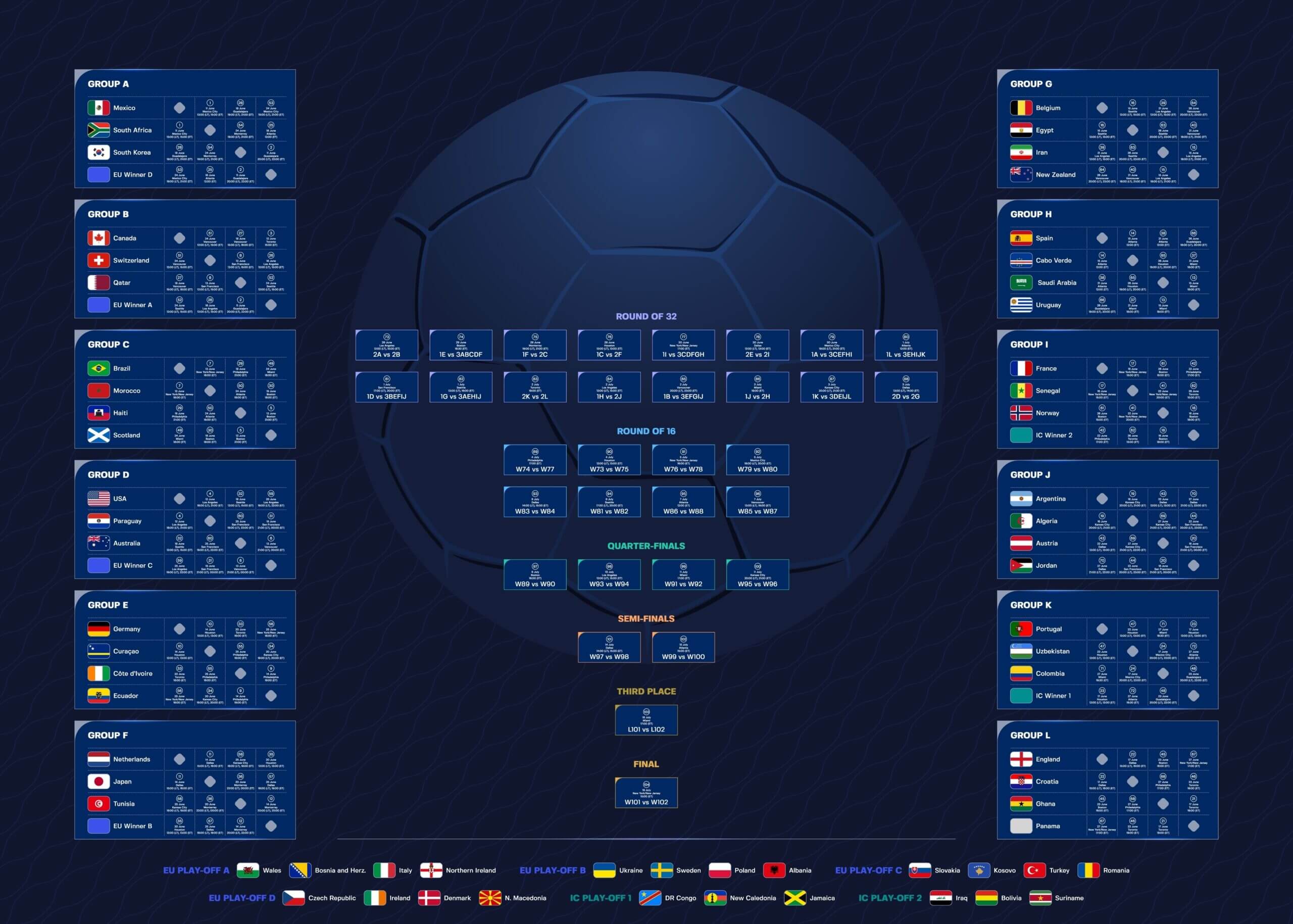
Simulated Matchups: What the Bracket Could Produce
Before the official draw, specific group assignments are unknown. But based on FIFA ranking tiers and the seeding logic FIFA has applied in recent tournaments, several compelling potential matchups emerge as genuinely probable:
Canada vs. USA in the Round of 32 or Round of 16
The bracket math makes a North American derby plausible as early as the Round of 32. If Canada wins their group and the USA finishes second in an adjacent group – or vice versa – the predetermined bracket structure could deliver the tournament’s most commercially compelling early knockout match. A Canada-USA knockout game on North American soil, in front of a split crowd at a stadium like AT&T Dallas or MetLife New Jersey, would be one of the most-watched soccer games in North American television history. At Canadian sportsbooks, expect the prop markets for this potential matchup to open as soon as the draw is made.
Argentina vs. France semi-final rematch
Argentina and France are typically seeded into opposite bracket halves, meaning the earliest they can plausibly meet is the semi-finals. A rematch of the 2022 final – arguably the greatest match in World Cup history – in a semi-final context would be the single most anticipated matchup of the tournament. The historical precedent of final rematches arriving at the semi-final stage is rare but not unknown; if both nations execute as expected through the bracket, 2026 could deliver it.
Ver esta publicación en Instagram
Spain vs. Germany quarter-final
Spain eliminated Germany from Euro 2024, ending Nagelsmann’s hopes in front of a home crowd. A 2026 World Cup quarter-final rematch between two of the tournament’s most technically accomplished nations – both capable of winning the title – would rank among the bracket’s most anticipated potential clashes. Their FIFA ranking positions make a quarter-final the most likely meeting point.
A Morocco knockout ambush
Morocco’s 2022 semi-final run wasn’t a statistical anomaly – it was the product of genuine defensive quality, elite goalkeeping, and remarkable collective discipline. In 2026, Morocco will enter as a known quantity rather than a surprise. But their capacity to win a knockout match against a theoretically superior opponent – organizing a low block, defending set pieces, and converting on the counter – makes them a structural threat to whichever European giant they draw in the Round of 32 or 16.
Favourites by Side of the Bracket
Even before the draw is conducted, broad bracket analysis is possible. FIFA ranking tiers determine seeding pods, and the predetermined bracket structure creates discernible “sides” that tend to be stronger or weaker based on how unseeded nations distribute.
| Tier | Nations | Bracket Risk Level | Likeliest Obstacle |
| Top seeds (automatic group control) | France, Brazil, England, Spain | Low – favourable group draws | Each other at semi-final stage |
| Second tier (strong unseeded) | Argentina, Germany, Portugal, Netherlands | Medium – potential group-stage tests | Top seeds in QF or SF |
| Co-hosts | Canada, USA, Mexico | Medium-Low – home advantage buffers | Second-tier European nations |
| Dark horses | Morocco, Japan, Senegal, Ecuador | High – face top seeds in Round of 32/16 | Match-specific upset windows |
The most dangerous bracket position belongs to whichever top European seed draws the “harder side” – the half that includes both Argentina and Germany, for example. World Cups have been won and lost based on which side of the draw a nation lands on, and 2026’s 12-group structure gives the bracket construction more variance than the familiar 8-group arrangement.
Potential Upsets That Could Reshape Everything
Upset potential in 2026 is structurally higher than at any recent tournament, for three specific reasons. First, the Round of 32 creates an early knockout match before teams have reached peak tournament conditioning – a window that favours a sharp, motivated lower-ranked opponent over a slightly complacent favourite. Second, the expanded 48-team field includes more nations from Africa and Asia than any previous tournament, bringing with it more genuinely unpredictable tactical profiles. Third, the tri-nation format with its travel demands creates physical variables that statistically increase the probability of sub-standard performances from physically tired squads.
The most statistically credible upset scenarios involve Japan or South Korea against a European second-tier nation in the Round of 32. Japan’s tactical sophistication – demonstrated by their group-stage victories over Germany and Spain at Qatar 2022 – and their capacity to organize an effective low block against possession-heavy opponents creates genuine danger for any nation that doesn’t study their structure with care. South Korea’s counter-attacking speed under a compact 4-4-2 defence is similarly difficult to manage in a single knockout game.
African nations collectively represent the tournament’s most concentrated upset potential. With nine AFC spots in 2026, the continent brings depth it has never previously had. A Senegal or Ivory Coast side with European-based talent throughout the roster – organized defensively and clinical on the counter – can beat anyone in the tournament on a given day.
For Canada specifically, the most dangerous Round of 32 scenario involves a European nation that excels at the kind of controlled possession Canada’s pressing system struggles against. A Netherlands or Belgium – comfortable in possession, capable of absorbing pressure and playing through it – represents a more dangerous stylistic matchup than a direct, physical opponent that plays into Canada’s counter-press strengths.
Betting Angles Built Around the Bracket
The bracket creates betting opportunities at multiple stages, and the most value-rich windows typically open and close quickly as new information arrives.
Pre-draw outright futures: Before the group draw, sportsbook pricing doesn’t account for bracket position. Historically, post-draw price adjustments for tournament favourites are modest – typically 5-15% movement – meaning the window immediately before the draw is made represents the best opportunity to lock in outright prices on nations likely to land in favourable bracket halves.
Group winner parlays: With 12 groups, building a same-tournament parlay across multiple group winner markets creates compound odds with manageable risk if the selections involve nations seeded into clearly weaker groups. A three-leg parlay combining France, Brazil, and Spain to win their respective groups might pay 4-6x at most sportsbooks – reasonable value given each nation’s individual probability.
Round of 32 live markets: The Round of 32 is entirely new territory for World Cup betting markets. There’s no historical pricing benchmark for this round specifically, meaning the first tournament cycle may produce systematic inefficiencies as sportsbooks calibrate in real time. Watch for lines that treat Round of 32 matches identically to Round of 16 historical comps – the earlier knockout stress tests in a compressed calendar have meaningfully different risk profiles.
Canada’s advancement odds: Les Rouges will be priced as an underdog in most markets relative to traditional soccer powers. But home-soil advantage, crowd support, and short travel distances create unmeasured upside that statistical models based purely on historical FIFA ranking performance don’t capture. Look for value in Canada’s Round of 16 advancement odds specifically – if they navigate the Round of 32, momentum and crowd energy could carry them further than the market prices.
The world cup bracket section of our site will track draw results and bracket positioning as they’re announced. Full match-by-match world cup betting odds are updated daily throughout the tournament.