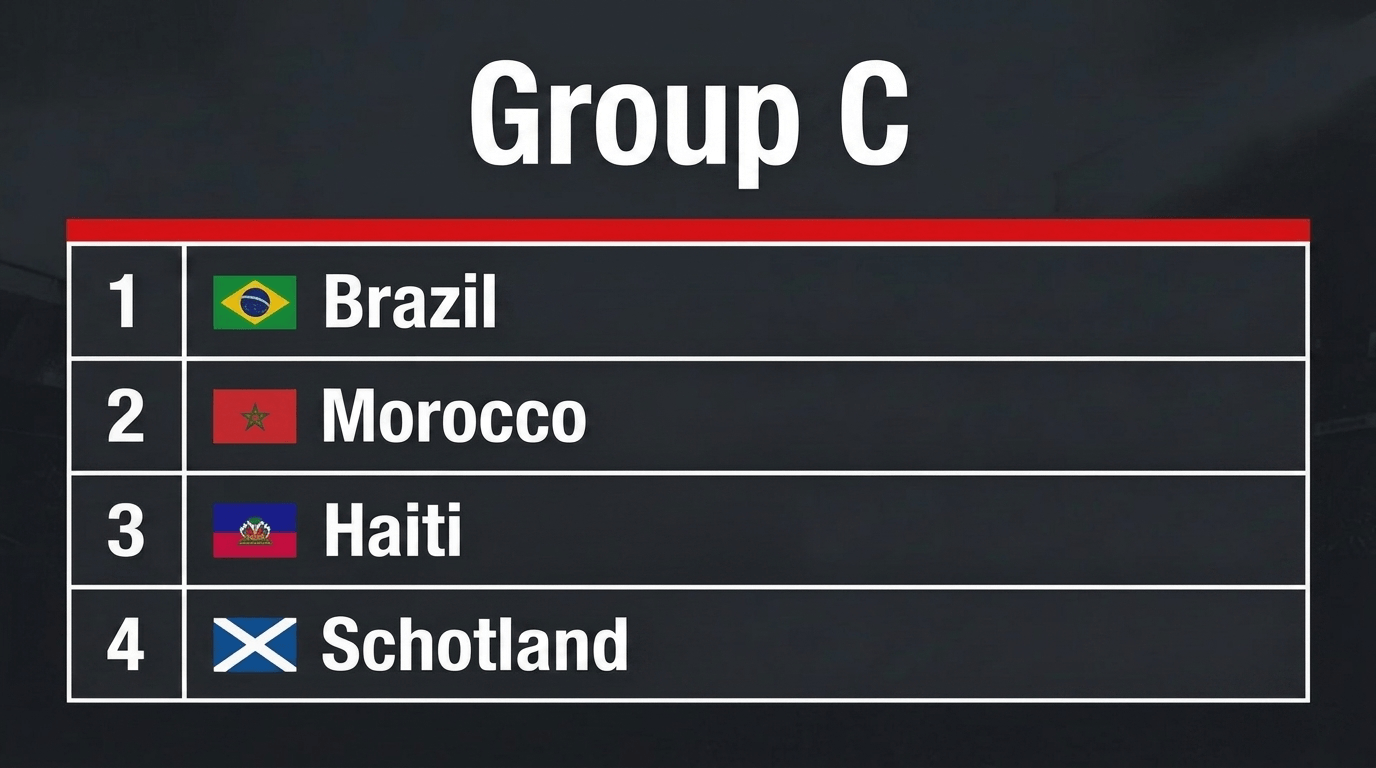
On paper, World Cup 2026 Group C is a two-horse race between Brazil and Morocco. In practice, the World Cup has a habit of making paper look foolish. Brazil arrive under Carlo Ancelotti following their most difficult CONMEBOL qualifying campaign of the modern era – talented but unresolved. Morocco, Africa’s first-ever semi-finalists from Qatar 2022, are now a cohesive, battle-hardened unit with legitimate ambitions beyond the group stage. Scotland return to the World Cup for the first time in 28 years, dragged there by two stoppage-time goals in Glasgow. Haiti, absent since 1974, will bring an organized resilience that is easy to underestimate. The Group C 2026 standings may look predictable by June 24 – or they might not. Here is our complete analysis.
Group C Overview
World Cup 2026 Group C brings together four nations whose storylines could not be more different. Brazil are soccer’s most decorated nation – five titles, the only team to qualify for every World Cup – yet they enter this tournament with legitimate tactical questions unresolved after a troubled qualifying campaign. Morocco are the ambition of an entire continent distilled into a tactically meticulous squad: eight wins from eight in African qualifying, two goals against. Scotland are making their first World Cup appearance since France 1998, having clawed through qualifying in the most dramatic fashion imaginable. Haiti – back at the global stage for the first time since 1974 – are organized, disciplined, and dangerous on the counter despite being overwhelming outsiders on paper. The early Group C predictions place Brazil and Morocco in the top two spots – but Scotland’s defensive solidity and Haiti’s counter-attacking structure make this group more volatile than the odds imply. Both of the first two Group C fixtures on June 13 will be broadcast across Canada on TSN, CBC, and DAZN.
Brazil: The Work in Progress Under Ancelotti
Carlo Ancelotti arrived in Brazil amid enormous fanfare and left CONMEBOL qualifying having secured the berth – but having also generated more questions than answers. Brazil’s campaign was, by any historical measure, their worst in the modern era: inconsistent results, defensive fragility, and a disjointed shape that the individual brilliance of their frontline could not consistently compensate for. A solid draw against Ecuador and a clinical win over Paraguay late in qualifying helped steady the ship, but the broader picture remains unresolved.
Ancelotti has shifted toward a more structured 4-3-3 or 4-2-3-1 in response, building a defensive block with clearer lines than his early selections provided. The attacking talent remains world-class by any measure: Brazil registered 365 successful dribbles in qualifying – the most of any CONMEBOL team – and three or four of their forward players operate at the elite end of European club soccer. Vinícius Júnior and Raphinha in particular give Brazil a dribbling and crossing threat that can unlock any backline. But coordination between defensive and attacking phases has been erratic, and Ancelotti himself has acknowledged the team is not yet the fluid, well-organized unit he envisions.
The opening Group C fixture – Brazil World Cup 2026 vs Morocco in New Jersey on June 13 – will be the definitive early signal. Win that game convincingly and this becomes a formality. Drop points against Morocco, and the pressure arrives immediately. Brazil remain our pick to top the Group C standings, but the version of Brazil that qualifies for 2026 is not the five-star juggernaut of popular imagination. They will be tested before the knockout stage.

Morocco: Africa’s Most Complete Footballing Nation
Morocco’s run to the semi-finals of Qatar 2022 was described at the time as a fairy tale. It was not. It was the product of meticulous defensive organization, a complete defensive roster, and the collective quality of a generation of Moroccan players born and raised in European academies. Walid Regragui has simply continued what that campaign made obvious: Morocco are no longer a feel-good story – they are a genuine World Cup contender.
Eight wins from eight in CAF qualifying, two goals conceded. The underlying defensive numbers are extraordinary, and they speak to a system – a 4-3-3 that transitions into a 4-1-4-1 as wide players drop – that is built to be nearly impossible to open up through sustained pressure. Achraf Hakimi attacks with the freedom of a winger from right-back; Azzedine Ounahi provides progressive ball-carrying under pressure with composure that rattles opponents who try to press him; and in Brahim Díaz, Hakim Ziyech, Youssef En-Nesyri, and Ayoub El Kaabi, Morocco have a creative and clinical frontline capable of punishing a single moment of defensive disorganization.
Regragui has been explicit about his dual identity: Morocco defend with intent, but they are not a defensive team. They want to control territory and then hurt teams quickly in transitions. Against Scotland and Haiti, that is a matchup Morocco should win comfortably. Against Brazil, it is a genuine tactical chess match between two well-coached sides – and one that will very likely determine who tops the Group C table.

Scotland: The Veterans Making History
Scotland’s qualification story deserves its own documentary. Trailing Denmark at Hampden Park with full time approaching, they scored twice in stoppage time to win 4-2 – overtaking Denmark at the top of their qualifying group and ending a 28-year World Cup absence. The noise in Glasgow that night was audible for miles. A nation that has spent three decades being the nearly-men finally got their moment.
Steve Clarke’s Scotland team is built on hard truths, not romantic notions. They are Europe’s oldest squad at this tournament – an average age of 28.8 years – which speaks to an experienced, pragmatic group of players who have seen enough to know that defending a lead for 80 minutes is a legitimate strategy. Their defensive approach is structured and effective: Scotland ranked third among UEFA nations in shots blocked per 90 minutes during qualifying (5.83 average), a figure that illustrates how many bodies they put between their own goal and an opposing attack.
In possession, Scotland are deliberate but controlled: 45.7% average possession, minimal long-ball usage at 12.2%, and a midfield capable of building through pressure when they need to. What they are is a set-piece team. Dead-ball situations – corners, free kicks, long throws – are the most likely source of goals against Brazil and Morocco. Scotland will not beat either of those sides in an open game. But with 85 minutes of disciplined defending and one set-piece conversion, taking four points from Scotland vs Morocco and Haiti vs Scotland is entirely achievable. Group C 2026 will show whether that hard-earned pragmatism is enough.
Haiti: The Tournament’s Most Resilient Underdogs
Haiti return to the World Cup for the first time in 52 years, and they do so not as happy participants but as an organized, tactically coherent outfit. Sebastian Migné’s team topped their CONCACAF qualifying group – ahead of Honduras, Costa Rica, and Nicaragua – with a 2-0 victory over Nicaragua sealing their passage. That is not luck. That is a well-drilled defensive unit doing its job under pressure.
The tactical evolution under Migné is the real story. Following a chastening 5-1 defeat against Curaçao during qualifying, he shifted Haiti’s shape markedly – dropping the defensive block deeper, tightening the lines, and relying on sharp, explosive counter-attacks rather than sustained possession. The numbers reflect the transformation: Haiti recorded the highest total of ball recoveries of any CONCACAF qualifier (436 recoveries), which means they are working at extraordinary defensive intensity to win back possession and transition quickly.
Their roster draws heavily on the Haitian diaspora – players based in France, Canada, and the United States – which means there is technical quality in this squad that does not always show up in a team ranked outside the top 80 in the world. Haiti will concede territory willingly against Brazil and Morocco. They will absorb pressure, stay organized, and look for any crack in the opposition’s defensive line to exploit in transition. A point against Scotland – a defensively minded side of similar ilk – is very much possible, and a win is not beyond imagination. Group C predictions that write Haiti off after 30 seconds of analysis are missing the point.
Group C Fixtures – All Times Eastern (ET)
| Date & Time (ET) | Match | Venue |
| Saturday, June 13 – 6:00 PM ET | Brazil vs Morocco | New York / New Jersey |
| Saturday, June 13 – 9:00 PM ET | Haiti vs Scotland | Boston |
| Friday, June 19 – 6:00 PM ET | Scotland vs Morocco | Boston |
| Friday, June 19 – 9:00 PM ET | Brazil vs Haiti | Philadelphia |
| Wednesday, June 24 – 6:00 PM ET | Brazil vs Scotland | Miami |
| Wednesday, June 24 – 6:00 PM ET | Morocco vs Haiti | Atlanta |
All Group C fixtures are available to Canadian viewers on TSN, CBC, CTV, RDS (French-language), and DAZN. The simultaneous June 24 double-header – where both Brazil vs Scotland and Morocco vs Haiti kick off at the same time – is the type of appointment television that defines the World Cup group stage. Set your reminders early.
Group C Odds and Predictions
The Group C odds leave no room for ambiguity at the top: Brazil and Morocco are the two sides Canadian sportsbooks including bet365, theScore Bet, and PointsBet expect to qualify, and the data supports that view. Scotland carry the best value of any side in the group as a potential qualifier, while Haiti are a historical longshot in the extreme.
| Team | To Qualify (Top 2) | To Win Group C |
| Brazil | -800 / 1.13 | -200 / 1.50 |
| Morocco | -400 / 1.25 | +280 / 3.80 |
| Scotland | +250 / 3.50 | +700 / 8.00 |
| Haiti | +700 / 8.00 | +2500 / 26.00 |
Brazil to qualify (-800) is the closest thing to a guaranteed outcome in World Cup 2026 Group C. Even an underperforming Brazil is several tiers above Scotland and Haiti, and Morocco – while genuinely strong – is not a team built to beat the Seleção over 90 minutes without significant fortune. Morocco to qualify (-400) is similarly safe but offers less juice for a parlay. The value in this group is Morocco to win it outright (+280): their defensive structure is built precisely to grind out a tight result against Brazil, and if they take three points on June 13, they run away with first place.
Scotland to qualify (+250) is the sharpest punt available in this group. Their defensive organization is legitimate – the shot-blocking stats tell you that – and all they need is to outperform Haiti in their direct match and take a point off Morocco. It’s a realistic path. Haiti to qualify is a true longshot; there is no analytical argument for backing them at the group stage, though Brazil vs Haiti futures in-game could generate interesting live odds if the match stays tight past the hour mark.
Our Group C 2026 prediction: Brazil top the group. Morocco advance in second place. Scotland exit with a hard-fought point. Haiti are winless but leave with dignity.
Group C standings forecast: 1. Brazil (7 pts) | 2. Morocco (6 pts) | 3. Scotland (1 pt) | 4. Haiti (0 pts)
Explore all group breakdowns at our World Cup 2026 Groups hub and get the freshest World Cup 2026 Odds at BettingSite.ca. More in our complete World Cup 2026 guide.