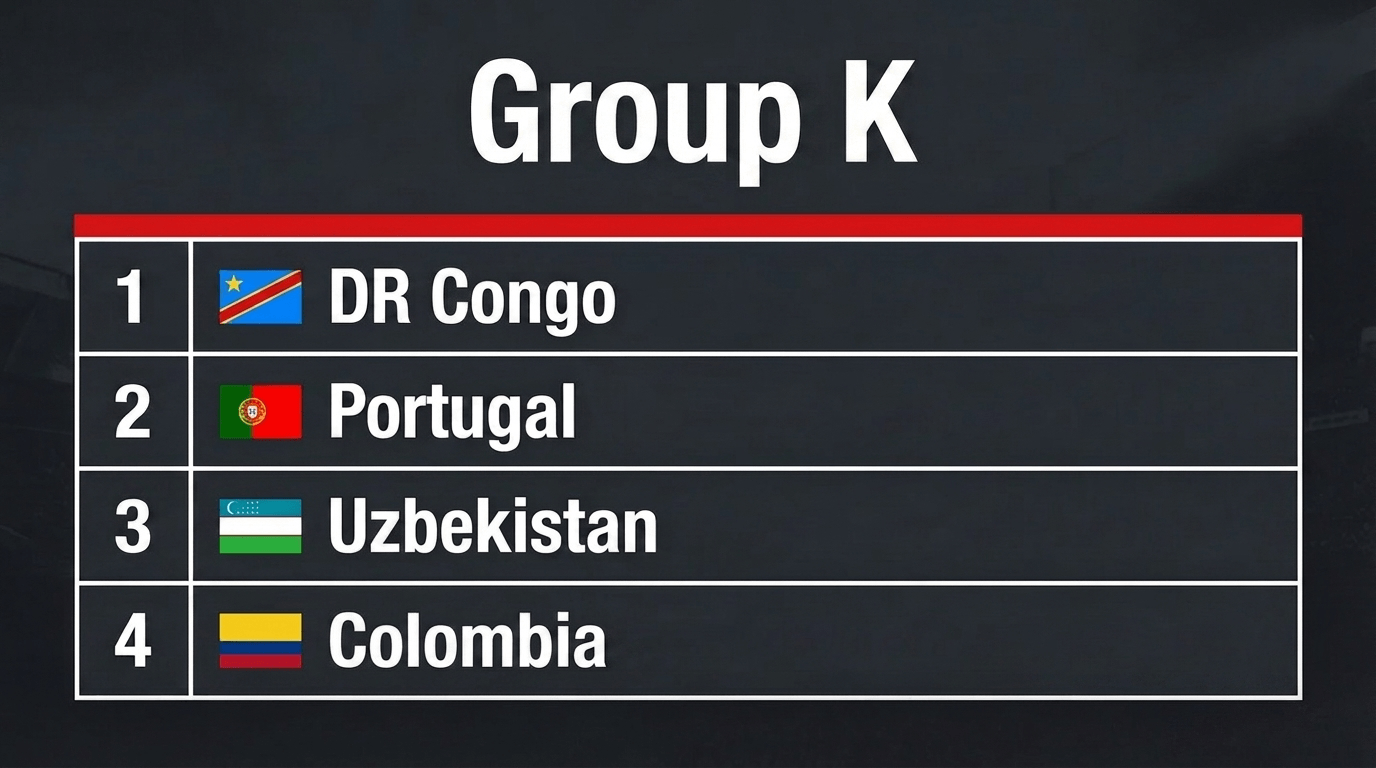
Two of the tournament’s most dangerous attacking nations head into World Cup 2026 Group K on a collision course that will not arrive until the final matchday. Portugal – record-breakers in European qualifying with a 71.0% average possession figure and an attack capable of producing scorelines like the 9-1 demolition of Armenia – are the headline act. Colombia, South America’s most prolific shooting team under Néstor Lorenzo, push for the group’s top spot with 247 qualifying shots and an attacking unit built around Luis Díaz, James Rodríguez, and a relentless full-back in Daniel Muñoz. Uzbekistan, making their World Cup debut, and DR Congo – returning after a 52-year absence – round out a group where the favourites are clear but the undercard is far from irrelevant. Group K 2026 may be the most entertaining group in the tournament. Here is our complete analysis.
Group K Overview
World Cup 2026 Group K is arguably the most offensively loaded group in the tournament, and the Group K standings race between Portugal and Colombia across three matchdays is one of the most compelling sub-plots of the entire group stage. Portugal arrive as European qualifying’s third-highest possession team at 71.0% and with a frontline that is simply relentless in its ability to create and convert. Colombia bring South America’s most dynamic attacking identity under Lorenzo – more shots and more crosses than any other CONMEBOL qualifier – backed by the creativity of James Rodríguez and the directness of Luis Díaz. Uzbekistan, appearing at their first World Cup under the stewardship of Italian legend Fabio Cannavaro, threaten through wide overloads and crossing volume. DR Congo, back for the first time since competing as Zaire in 1974, possess attacking talent in Yoane Wissa and Cédric Bakambu but struggle to convert shot volume into goals consistently. The Group K predictions are clear – Portugal and Colombia qualify – but the order of the Group K table going into the knockout stage will be decided by their direct match in Miami on June 27. Canadian fans can watch all Group K action on TSN and DAZN.
Portugal: The Midfield Balance They Need to Find
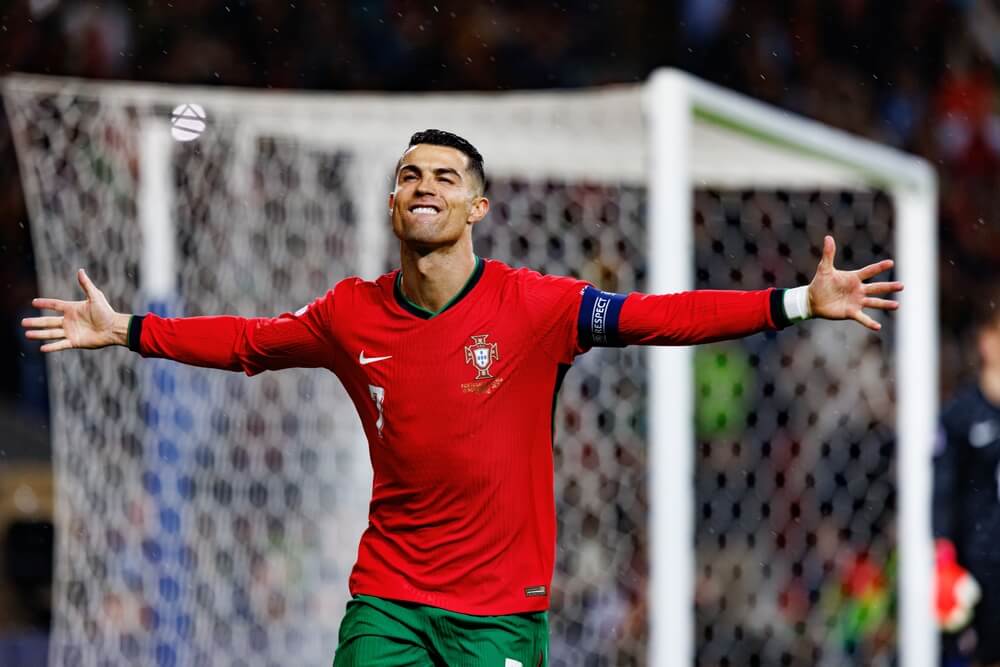
Roberto Martínez has made Portugal one of the most possession-dominant international teams on the planet. Their 71.0% average possession across European qualifying – third highest in UEFA – is a reflection of a team that genuinely controls matches through ball-retention rather than just recycling safely. Against Armenia, they scored nine. Against most opponents, Portugal’s frontline creates chances at a rate that few teams in the world can match.
The persistent structural question, however, is one that Martínez has not yet fully resolved: midfield balance. Portugal’s preferred lineup often features five players with primarily attacking instincts, supported by creative central midfielders rather than ball-winning specialists. When Portugal have the ball – which is most of the time – this creates an extraordinary richness in front of the opposition. When Portugal lose the ball, the transition back to a defensive shape can leave the backline exposed to quick counters, because the midfield screen is not built from true defensive-minded players.
In Group K 2026, this matters most against Colombia – the one side capable of pressing Portugal high and exploiting transitions. Against Uzbekistan and DR Congo, Portugal World Cup 2026 should be comfortable regardless of the midfield structure: the frontline quality is simply too high to be neutralized by either debutant. But if Martínez does not adjust the midfield balance for the Colombia match – bringing a more combative profile into the centre – Portugal’s attack-minded shape could gift Lorenzo’s side the precise spaces they specialize in exploiting. Group K predictions still have Portugal qualifying, but the group winner question hinges on a system decision that has been deferred all qualification.
Colombia: South America’s Most Dangerous Shooting Team
Colombia missed Qatar 2022, and they have channelled that frustration into one of the most emphatically attacking qualifying campaigns CONMEBOL has seen in recent memory. Under Néstor Lorenzo, the Cafeteros produced more shots (247) and sent more crosses into the box (300) than any other South American qualifier – not by a small margin, but by a meaningful statistical gap. This is a team that genuinely overwhelms opponents through repetition, volume, and pressure.
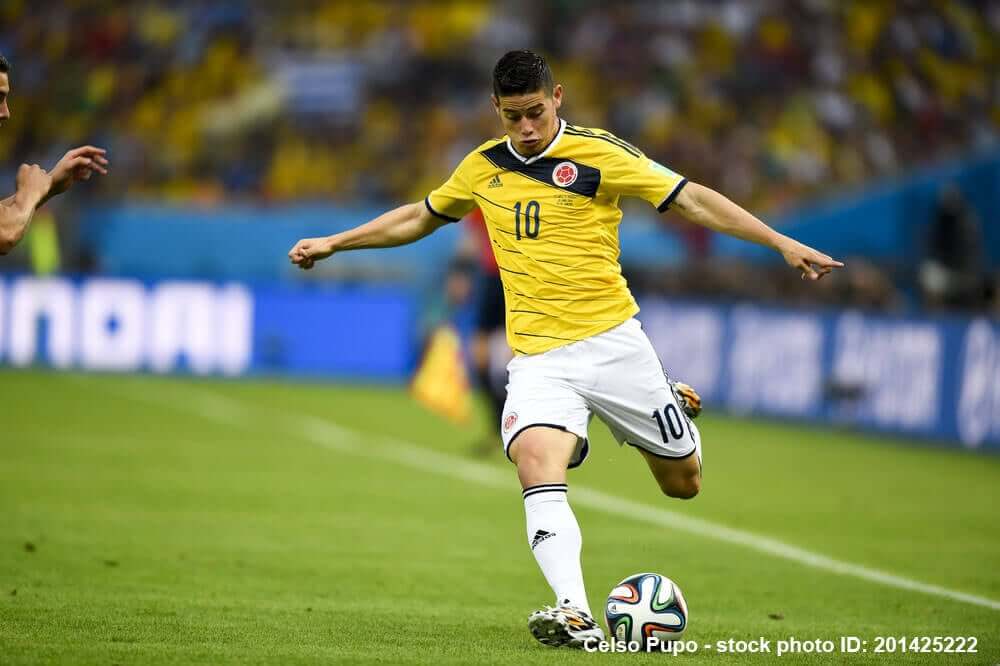
The architecture of Colombia’s attack is multi-threaded. Luis Díaz drifts in from the left, bending toward the central lanes where he is most dangerous in front of goal. James Rodríguez finds the pockets of space between opposition lines as a creative hub – his vision, range of passing, and ability to draw defenders out of position remain elite. On the right flank, Daniel Muñoz provides a constant stream of overlapping runs and crosses that give Colombia width and a secondary source of danger from deep positions. A historic 3-0 win over Bolivia in front of a packed Estadio El Campín, with James opening the scoring, confirmed their place in the field.
Colombia World Cup 2026 carries more than just individual quality – it carries a system. Lorenzo’s 4-3-3 combines organizational discipline with genuine penetration, and Colombia’s shot-volume numbers suggest they generate dangerous situations at a rate that even defensively organized opponents struggle to contain for 90 minutes. Their Group K fixtures set up perfectly: Uzbekistan first, then DR Congo, then Portugal in Miami. Win the first two, and the Portugal match becomes the championship decider for who tops the Group K table.
Uzbekistan: Wide Threats and a Debut to Savour
Uzbekistan’s qualification for their first-ever World Cup – secured by finishing in the top two of their AFC third-round group – is a landmark moment for Central Asian soccer, and the White Wolves arrive in North America with a tactical identity that is more defined than many will expect. Under the recently appointed Fabio Cannavaro – the Italian World Cup winner who took over ahead of the tournament – Uzbekistan play a 3-4-3 or 3-5-2 with licence for their wing-backs to attack aggressively in wide channels.
The numbers from qualifying are revealing: 222 crosses attempted and 160 shots generated across the campaign. This is a team that generates its offensive output almost entirely through wide positions – crossing early, crossing often, and relying on movement in the box to create second-ball and header opportunities. Abdukodir Khusanov, the Manchester City defender, provides the athletic backbone of their defensive structure – his pace in recovery allows the system’s higher line to function without being constantly exposed in behind.
Against Portugal and Colombia, Uzbekistan will likely be out-possessed significantly and will need to defend deep for long periods. Their best realistic hope in the Group K standings is a single positive result – most plausibly against DR Congo – and the accumulation of enough credit to avoid a group-stage exit by a punishing goal difference. The World Cup debut is what matters most; how they perform within it will determine whether Central Asian soccer leaves this tournament with a moment to build on.
DR Congo: Potential That Keeps Stopping Short
The Democratic Republic of Congo return to the World Cup – their first appearance since competing as Zaire at the 1974 tournament – after a playoff victory over Jamaica. The winning goal, scored by Axel Tuanzebe in extra time, sent the Leopards through. The margin of victory in that playoff was a single goal, which encapsulates DR Congo’s World Cup qualification story: close, dramatic, and ultimately decisive.
Coach Sébastien Desabre has assembled a roster with legitimate attacking talent. Yoane Wissa brings prolific goalscoring at club level; Cédric Bakambu offers experience and clinical movement; Théo Bongonda adds pace and technical quality in wide positions. The right-back axis of Aaron Wan-Bissaka and Axel Tuanzebe provides Premier League quality and reliability in the defensive third. Chancel Mbemba anchors the central defensive line with authority. The defensive structure is the clearest strength of this team – DR Congo conceded just one goal in their final four qualifying matches, a run of results that suggests Desabre has found a defensive formula that holds.
The recurring limitation is in front of goal. During the Africa Cup of Nations, DR Congo maintained strong shot volumes but consistently failed to convert at an acceptable rate, and against better-organized opponents – precisely the type they will face in World Cup 2026 Group K – their offensive production collapsed. Portugal and Colombia will likely find the Leopards easier to defend against than their attacking roster might suggest. Uzbekistan represents the most winnable match of their group stage. If Wissa, Bakambu, or Bongonda can rediscover their club-level form, a positive Group K result is possible – but it requires the conversion issues to be resolved in a very short window.
Group K Fixtures – All Times Eastern (ET)
| Date & Time (ET) | Match | Venue |
| Wednesday, June 17 – 1:00 PM ET | Portugal vs DR Congo | Houston |
| Wednesday, June 17 – 10:00 PM ET | Uzbekistan vs Colombia | Mexico City |
| Tuesday, June 23 – 1:00 PM ET | Portugal vs Uzbekistan | Houston |
| Tuesday, June 23 – 10:00 PM ET | Colombia vs DR Congo | Guadalajara |
| Saturday, June 27 – 7:30 PM ET | Colombia vs Portugal | Miami |
| Saturday, June 27 – 7:30 PM ET | DR Congo vs Uzbekistan | Atlanta |
All Group K fixtures are live in Canada on TSN, CBC, CTV, RDS (French-language), and DAZN. The June 27 evening double-header – Colombia vs Portugal in Miami alongside DR Congo vs Uzbekistan in Atlanta, both simultaneous – is one of the most anticipated group-stage closers in the bracket. Set your schedule for 7:30 PM ET on June 27. It could be very, very good.
Group K Odds and Predictions
The Group K odds at top Canadian sportsbooks like bet365, PointsBet, and theScore Bet have Portugal and Colombia as significant co-favourites to qualify, with Uzbekistan and DR Congo both listed as longshots to spring a surprise. The real question is not who qualifies – it is who wins the Group K table heading into the knockout bracket.
| Team | To Qualify (Top 2) | To Win Group K |
| Portugal | -800 / 1.13 | -250 / 1.40 |
| Colombia | -500 / 1.20 | +220 / 3.20 |
| Uzbekistan | +350 / 4.50 | +1500 / 16.00 |
| DR Congo | +400 / 5.00 | +2000 / 21.00 |
For World Cup 2026 odds bettors focused on Group K predictions, Portugal to qualify (-800) and Colombia to qualify (-500) are the foundation of any Group K parlay – both prices reflect near-certainties. The tactical question is whether one of them can catch the other on June 27 in Miami, which makes Colombia to win the group (+220) an analytically supported bet. Lorenzo’s side has a shot-generation machine that could overwhelm Portugal’s defensively questionable midfield structure – and the incentive of topping the group draws out the best in Colombia’s attacking identity.
Uzbekistan to qualify (+350) and DR Congo to qualify (+400) are longshots that require one or both favourites to dramatically underperform. There is no data-driven argument for backing either as a standalone qualifier, though including one in a large-field parlay at those prices adds value relative to the risk.
The defining parlay for this group: Colombia to win Group K (+220) combined with Portugal to qualify (-800). It accounts for a Colombia upset in the final match while acknowledging that Portugal will advance regardless of result.
Our Group K 2026 prediction: Colombia edge Portugal to top the group following the June 27 match in Miami. Portugal advance in second with a superior goal difference over the first two matches. Uzbekistan push DR Congo hard but both exit without advancing.
Group K standings forecast: 1. Colombia (7 pts) | 2. Portugal (7 pts) | 3. Uzbekistan (3 pts) | 4. DR Congo (0 pts)
Follow the Portugal vs Colombia showdown and every Group K update at our World Cup 2026 Groups hub. All live odds are tracked at World Cup 2026 Odds. The complete guide is at World Cup 2026.