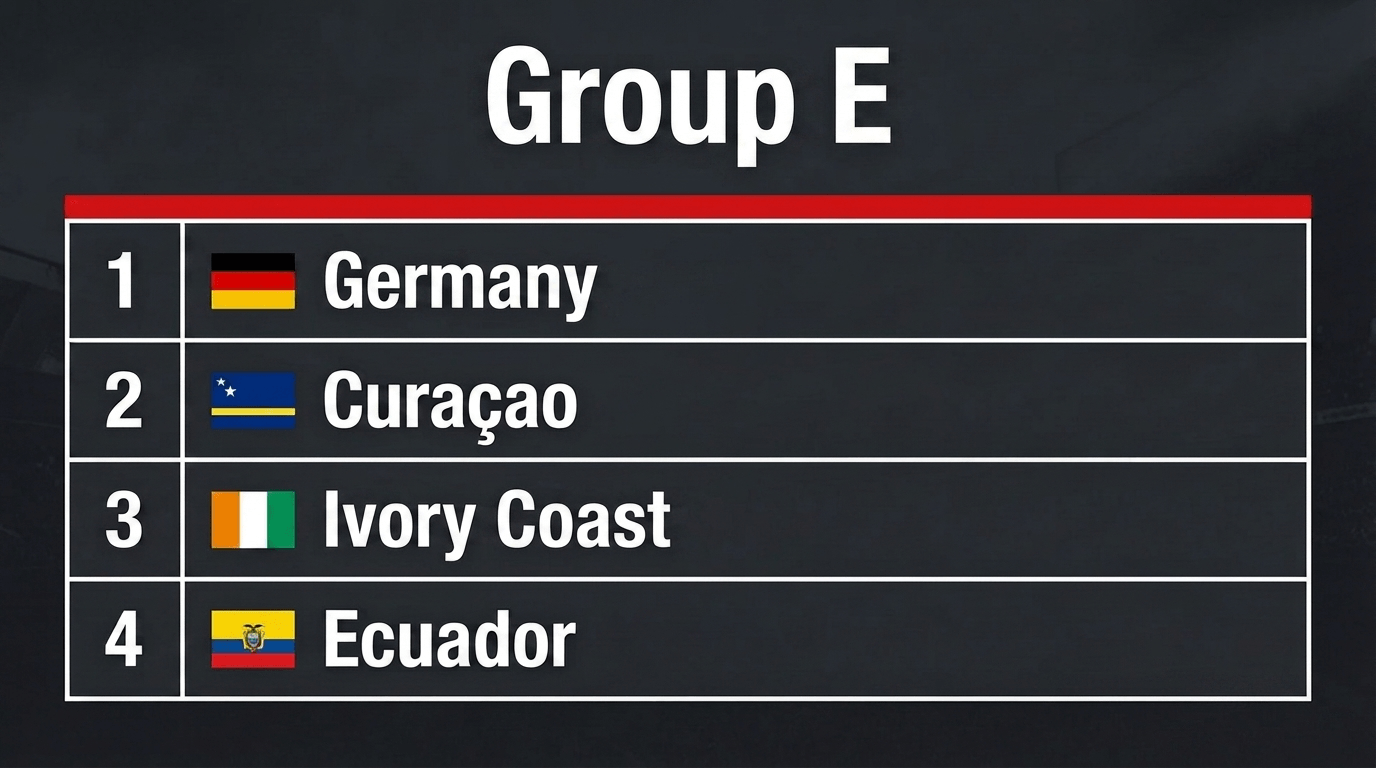
World Cup 2026 Group E is where Germany return to the global stage with a point to prove, and where three very different nations fight for the right to join them in the round of 32. Julian Nagelsmann’s rebuilt side – whose 6-0 destruction of Slovakia secured their qualifying berth – brings elite possession, a relentless press, and the most dangerous creative midfield pairing at the entire tournament. Standing between them and a clean group sweep are an Ivory Coast squad with a 25-0 qualifying goal differential, an Ecuador side that conceded just five goals across 18 CONMEBOL matches, and Curaçao – making their first World Cup appearance with a European tactical philosophy and legitimate CONCACAF pedigree. Group E fixtures run through Houston, Philadelphia, Toronto, Kansas City, and New York/New Jersey, with the Toronto matchday bringing the tournament to Canadian soil.
Group E Overview
World Cup 2026 Group E contains the clearest hierarchy of any group in this tournament – and simultaneously one of the most unpredictable second-place races. Germany qualified for their 19th consecutive World Cup with statistical dominance that borders on overwhelming: 72.7% average possession and a PPDA of 7.50 across the UEFA qualifying phase, the latter placing them among Europe’s most aggressively pressing teams. But while Nagelsmann’s side are heavy favourites to top the group e standings, the race behind them is genuinely open. Ivory Coast produced a perfect 25-0 aggregate qualifying record, leading Africa’s Group F and arriving in North America with structural depth that extends well beyond individual stars. Ecuador, operating under Sebastián Beccacece’s defensive blueprint, conceded just five goals in 18 CONMEBOL matches – the second-best record in the confederation – to qualify with two rounds to spare. And Curaçao, in their first-ever World Cup, represent the CONCACAF region with a pressing style, 28 qualifying goals across three stages, and a squad built almost entirely on Dutch football foundations. The World Cup 2026 group stage rarely delivers a cleaner setup: one dominant force, three credible challengers fighting for one spot.
Germany: Nagelsmann’s High-Press Machine Demands Respect
Julian Nagelsmann was handed a clear brief when he took the Germany job: restore order, rebuild identity, and end the humiliation of back-to-back group stage exits at the 2018 and 2022 World Cups. By the time Germany swept Slovakia 6-0 to clinch top spot in UEFA Group A, it was clear the brief had been executed with surgical precision. Die Mannschaft have not merely qualified – they have rediscovered the structural coherence that made them a legitimate World Cup force for three decades.
The tactical system shifts fluidly between a 4-1-3-2 and a 4-2-3-1, but the conceptual core is fixed: Florian Wirtz and Jamal Musiala operate as interchangeable “10s,” each capable of receiving between defensive and midfield lines, turning at speed, and either releasing teammates or driving forward independently. Their combination eliminates Germany’s historical reliance on a dominant target striker by generating scoring opportunities through movement and positional intelligence rather than individual finishing. The fullbacks push high and wide in both systems, stretching defensive shapes before Wirtz and Musiala exploit the central channels that open as a result.
The 72.7% possession average and 7.50 PPDA from qualifying are not just impressive numbers – they reflect a team philosophy that is both proactive and self-reinforcing. Germany win the ball back quickly through organized pressing, then use their technical superiority to control the following possession phase. For world cup 2026 group e analysis, the only genuine question around Germany is not whether they advance but whether Nagelsmann can maintain the discipline and intensity across three group stage matches against opponents of varying quality. The Germany that dominates possession is devastating; a complacent Germany, underestimating a compact defensive setup, is occasionally vulnerable to moments of transition. The risk is minimal, but it exists.

Ivory Coast: Structure, Depth, and a Flawless Qualifying Record
A 25-0 aggregate goal differential across ten African qualifying matches is a number that demands serious attention. Emerse Faé’s Ivory Coast did not merely qualify for the 2026 World Cup – they led Africa’s Group F without conceding a single goal, which means their defensive record over the qualifying phase matches their attacking one in terms of absolute authority. This is not a side coasting on individual brilliance; it is a team that has been built with collective coherence as its primary architectural principle.
Faé deploys a disciplined 4-3-3 that transitions into a 4-2-3-1 when facing well-organized opposition away from home. The fundamental mechanism is consistent: control possession through a physically dominant central midfield, use the fullbacks’ pace to generate width, and exploit the versatility of the wide forwards – who are capable of switching flanks, combining centrally, or running in behind – to unlock defensive blocks. The spine of the team functions as a genuine collective rather than as support structure for one or two recognized stars, giving Ivory Coast a resilience that more talent-dependent African sides have historically lacked at World Cups.
Their opening fixture against Ecuador in Philadelphia is the group’s most important Matchday 1 match for group e predictions. A win there would almost certainly confirm Ivory Coast’s passage to the round of 32 regardless of what follows against Germany and Curaçao. Faé’s team is built precisely for this kind of tournament soccer: organized, efficient in both phases, capable of absorbing periods of pressure, and sharp enough on the counter to punish teams that overcommit. African champions rarely arrive at a World Cup with this level of structural clarity. The group e world cup 2026 market that prices Ivory Coast as second-choice qualifiers is not mispriced – but it is close.
Ecuador: Beccacece’s Fortress and the Counter-Attacking Blueprint
Five goals conceded in 18 CONMEBOL qualifying matches. Let that number settle for a moment. In a South American qualifying campaign that includes Brazil, Argentina, Uruguay, and Colombia as opponents, Sebastián Beccacece’s Ecuador were scored against just five times across nearly two full years of competitive football. That is not a defensive record; it is a feat of collective engineering. Ecuador sealed qualification with two rounds to spare courtesy of a goalless draw in Lima against Peru – a result that, for Beccacece’s team, represented a typical working evening rather than a desperate rearguard.
The system alternates between a 4-2-3-1 and a 5-4-1 depending on the opposition, with the defensive shape as the constant across both. A third of Ecuador’s qualifying matches ended 0-0 – which represents both a defensive triumph and an honest admission of the team’s attacking limitations. When they do score, it tends to be quickly and directly: Beccacece’s players are drilled to transition from defensive compactness to forward momentum with minimal lateral passes, exploiting the space that pressing opponents leave behind their defensive line. This is not pretty football, but it is tournament football, and it is precisely the kind of approach that causes problems for possession-dominant teams like Germany.
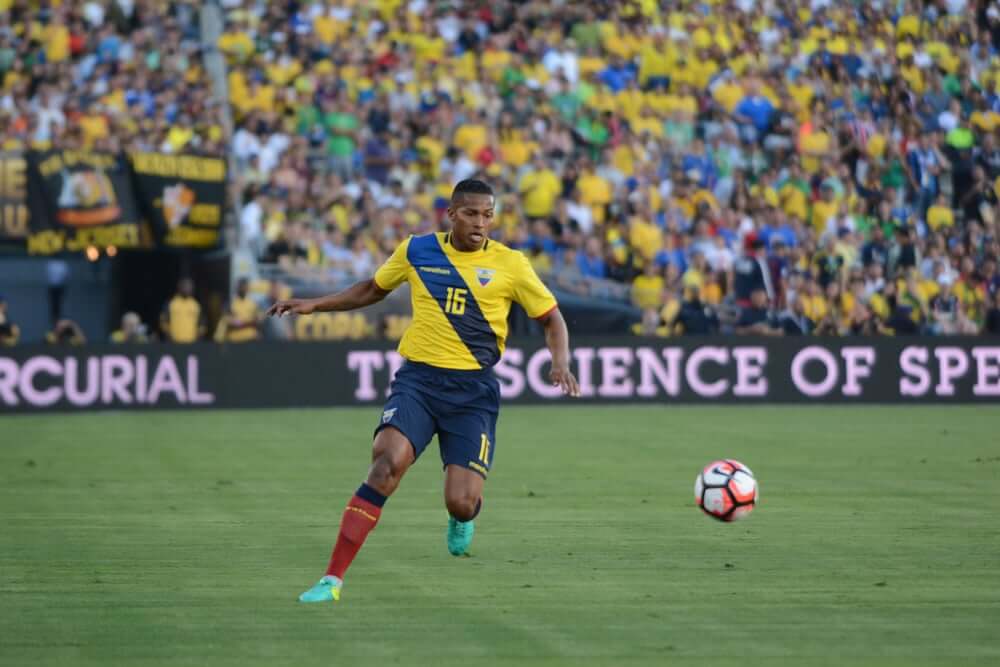
Ecuador’s path through world cup group e will be defined by their Matchday 1 result against Ivory Coast in Philadelphia. A point there – entirely achievable given their defensive record – gives them the flexibility to play for a draw against Germany in New York/New Jersey on Matchday 3, where a tactical counter-attacking approach on a specific day could yield something unexpected. For group e odds shoppers, Ecuador’s defensive solidity makes them one of the group’s more interesting value plays. They will not be entertaining, but they are very unlikely to be beaten easily.
Curaçao: The Caribbean’s Most Sophisticated World Cup Debut
No team at the 2026 World Cup carries a more improbable backstory than Curaçao. An island of fewer than 200,000 people, competing in their first-ever World Cup, having squeezed through CONCACAF qualifying with a tense goalless draw against Jamaica in their final group match. Yet strip away the narrative and examine the numbers, and you find a team that is far more than a sentimental selection.
Dick Advocaat – whose entire coaching career has been spent in European football – has built a 4-3-3 that is distinctly Dutch in its conception: organized out of possession, proactive with pressing (a PPDA of 9.55 is one of CONCACAF qualifying’s most aggressive figures), and structured to generate attacks through overlapping fullbacks and midfield runners. The Bacuna brothers, Leandro and Juninho, provide creativity and dynamism from central midfield positions. Curaçao finished as the highest scorers across all three CONCACAF qualifying stages combined, with 28 goals – a total that required genuine technical quality to accumulate, not just favorable fixtures. They also kept clean sheets in six of their ten qualifying matches, suggesting the defensive organization is authentic rather than incidental.
For group e table projections, Curaçao’s realistic expectation is third or fourth. Against Germany and Ivory Coast, Advocaat will almost certainly set up to defend compactly and counter at pace – the natural adjustment for a squad that has spent its preparation playing opponents below international elite level. The Ecuador match in Kansas City on Matchday 2 at 11:00 PM ET is their most realistic opportunity for a competitive result. And their Matchday 1 clash in Houston against Germany – the tournament’s most anticipated debut fixture – will provide an immediate measure of just how ready Curaçao truly are for this stage. Their first World Cup is not just symbolic; it is the product of real footballing development, and Advocaat’s side will carry it with appropriate seriousness.
Group E Fixtures: Full Schedule in Eastern Time (ET)
Below are all six group e fixtures at the 2026 World Cup, with kickoff times in Eastern Time (ET). The Toronto match – Germany vs Ivory Coast on June 20 at 4:00 PM ET – brings World Cup football to Canadian soil. Catch every match on TSN, CBC, CTV, and RDS in French.
| Matchday | Date | Match | Time (ET) | Venue |
| MD 1 | Sun, June 14 | Germany vs Curaçao | 2:00 PM ET | NRG Stadium, Houston |
| MD 1 | Sun, June 14 | Ivory Coast vs Ecuador | 7:00 PM ET | Lincoln Financial Field, Philadelphia |
| MD 2 | Sat, June 20 | Germany vs Ivory Coast | 4:00 PM ET | BMO Field, Toronto |
| MD 2 | Sat, June 20 | Ecuador vs Curaçao | 11:00 PM ET | Arrowhead Stadium, Kansas City |
| MD 3 | Thu, June 25 | Curaçao vs Ivory Coast | 4:00 PM ET | Lincoln Financial Field, Philadelphia |
| MD 3 | Thu, June 25 | Ecuador vs Germany | 4:00 PM ET | MetLife Stadium, New York/New Jersey |
The simultaneous Matchday 3 kickoffs – Curaçao vs Ivory Coast and Ecuador vs Germany at 4:00 PM ET on June 25 – are the group’s climactic moment. Canadian viewers in Toronto will have already seen Germany and Ivory Coast square off at BMO Field on June 20, one of the tournament’s most anticipated Canadian-hosted fixtures.
Group E Odds: Germany Lead, But Second Place Is Wide Open
The World Cup 2026 odds on group e world cup 2026 are dominated by Germany’s presence, with the four-time world champions priced as heavy group winners at odds that leave little room for nuance. Here are approximate group e odds from major Canadian sportsbooks:
| Team | To Win Group E | To Qualify (Top 2) |
| Germany | -400 | -900 |
| Ivory Coast | +500 | -120 |
| Ecuador | +650 | +115 |
| Curaçao | +2500 | +450 |
Germany’s odds to win the group reflect the mathematical reality: a 72.7% possession average, seven PPDA pressing intensity, and the Wirtz-Musiala creative axis represent a combination that no group stage opponent is equipped to neutralize consistently. The value in betting on Germany is not at the group winner line but in specific performance markets – total goals, first scorer, and clean sheet odds – where Nagelsmann’s aggressive pressing system creates reliable statistical patterns.
Ivory Coast at -120 to qualify is the group’s closest thing to a secure secondary bet. The 25-0 qualifying record was not built against weak opponents; it reflects a genuine tactical maturity under Faé that will not suddenly evaporate against Ecuador and Curaçao. The risk factor is the Germany match in Toronto, which could produce a heavy defeat affecting goal differential in tight qualification scenarios. Ecuador at +115 to qualify is the contrarian play: five goals conceded across 18 CONMEBOL matches is the kind of defensive record that wins tight group stage points against Ivory Coast on a day when neither team produces much offensive quality.
For who will qualify from group e, the betting consensus points firmly to Germany first and Ivory Coast second – with Ecuador representing the value challenge to that narrative. Curaçao’s inaugural World Cup is a story worth following closely, but their qualification odds reflect a realistic assessment of the gap between CONCACAF qualifying and the demands of a group containing the world’s most effective pressing team. Follow all group e standings developments through our World Cup 2026 hub.