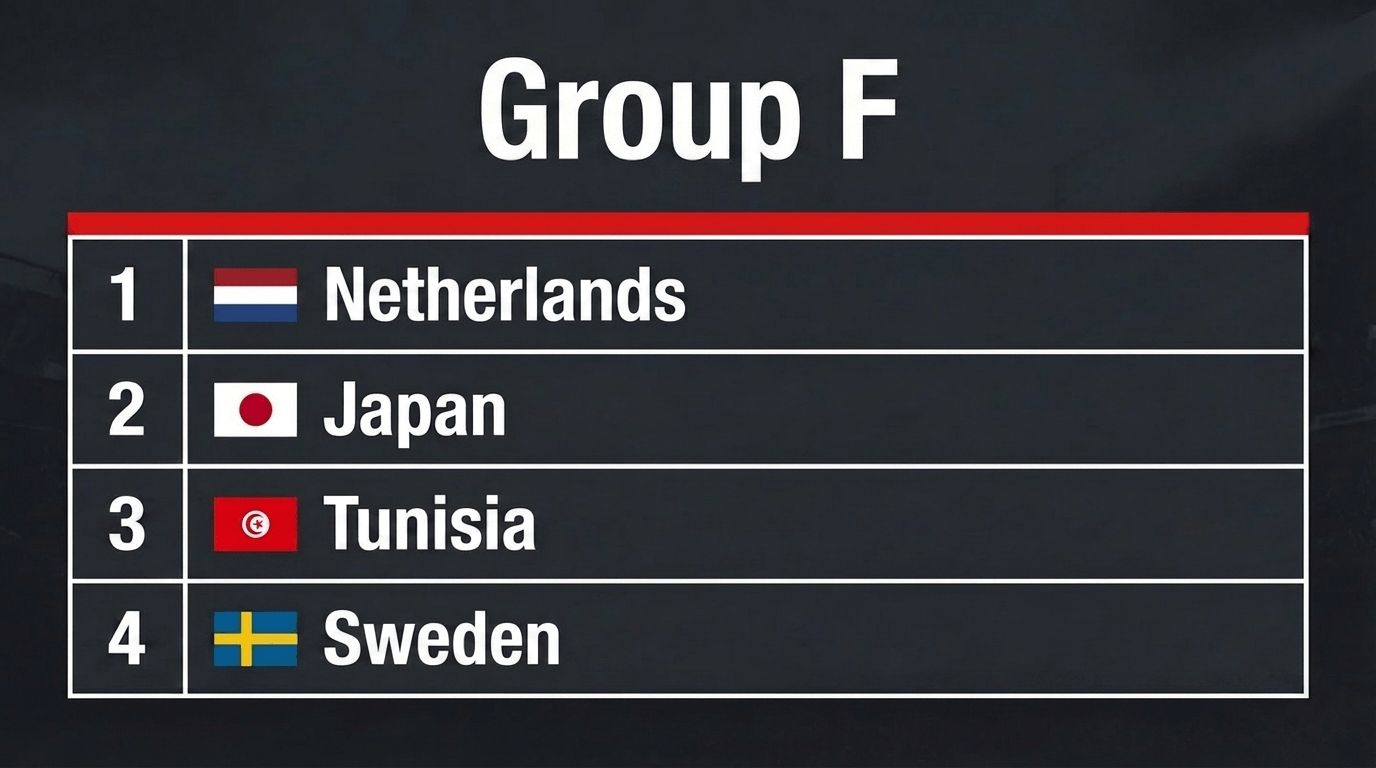
Every World Cup produces one group where the qualification stories are more compelling than the football itself – and then the football turns out to be just as dramatic. World Cup 2026 Group F may be that group. The Netherlands arrive as measured favourites after an unbeaten European qualifying campaign under Ronald Koeman. Japan bring 51 goals and a tactical sophistication that made Asian qualifying look like a controlled experiment. Sweden – who finished last in their UEFA qualifying group without a single win – rode Viktor Gyökeres’s four-goal playoff explosion all the way to North America. And Tunisia, who kept clean sheets in ten consecutive African qualifying matches, raise the essential question: can defensive perfection survive a group containing three teams capable of creating from anywhere?
Group F Overview
World Cup 2026 Group F spans four nations whose paths to North America could not have been more different, and whose tactical philosophies diverge almost completely. Ronald Koeman’s Netherlands clinched qualification with a 4-0 final-match victory over Lithuania, completing the campaign unbeaten and securing their 12th World Cup berth with a pragmatic, adaptable approach that has moved Dutch football away from ideological rigidity toward genuine effectiveness. Japan dominated Asian qualifying with numbers that strain credibility – 51 goals, 188 chances created, 149 key passes, and six corner kick goals – all while playing a pressing-intensive 3-4-2-1 system that generates constant positional advantages. Sweden’s qualification story is one of the tournament’s great improbable narratives: last in their UEFA group, rescued by the Nations League playoff, then carried through two playoff matches almost exclusively by Viktor Gyökeres. Tunisia complete the picture with a 10-clean-sheet African qualifying campaign that represents the most complete defensive record on the continent. The race for second place in the group f standings is genuinely open across three matchdays in Dallas, Houston, Monterrey, and Kansas City, with Canadian fans following every kick via World Cup 2026 group coverage on TSN and CBC.
Netherlands: Koeman’s Pragmatic Oranje Return to Contention
The Dutch have spent the last decade oscillating between moments of genuine quality and puzzling inconsistency, but Ronald Koeman’s second stint as national team coach has brought a stability that the Oranje had been missing since their 2014 World Cup semi-final run. Qualifying unbeaten through UEFA’s Group G – capped by a confident 4-0 win over Lithuania in Amsterdam – delivered their 12th World Cup berth and confirmed that Koeman’s reconstruction project is structurally sound.
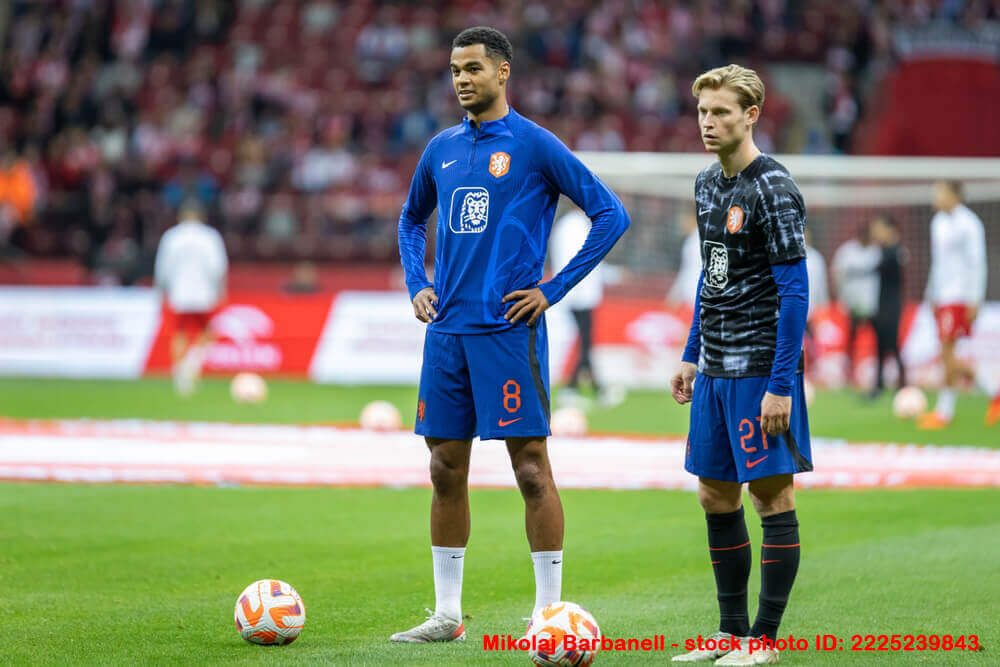
What defines this Netherlands team most clearly is tactical flexibility without identity loss. Koeman alternates between a 4-2-3-1, a 4-3-3, and occasional three-defender arrangements, reading the game and adjusting rather than imposing a single template. Denzel Dumfries provides the majority of the team’s right-side width, operating as an attacking wing-back whose offensive output is substantial – he functions almost as an auxiliary winger in possession phases. The central midfield distributes efficiently, while the Netherlands ranked second in progressive passes (724) across European qualifying, a figure bettered only by England and indicating a team that consistently advances possession into dangerous areas rather than recycling it laterally. The wide forwards recorded elite dribble completion numbers, and Virgil van Dijk anchors a defensive structure that was rarely genuinely threatened across qualifying.
For group f world cup 2026 analysis, the Netherlands are the group’s clear first-place favourites, and that assessment is well-founded. The tactical range that Koeman provides – the ability to play narrow or wide, compact or expansive – means Japan’s pressing system, Sweden’s directness, and Tunisia’s defensive organization each present different challenges that the Dutch are equipped to handle. The one uncertainty is whether Koeman’s measured approach produces the kind of dominant group stage performances that generate momentum heading into the knockout rounds, or whether the pragmatism leads to unconvincing wins that leave questions unanswered.
Japan: 51 Goals, an Elite System, and a Point to Prove
The numbers from Japan’s Asian qualifying campaign require a second reading. Fifty-one goals. An expected goals (xG) of 30.18. One hundred and eighty-eight scoring chances created. One hundred and forty-nine key passes. Six goals converted directly from corner kicks. By any reasonable metric, Hajime Moriyasu’s side delivered one of the most prolific qualifying campaigns of any team heading to the 2026 tournament – which makes their underdog framing in most world cup group f market assessments feel like a significant structural mispricing.
The 3-4-2-1 is the system, and its brilliance lies in the precision of the movement patterns rather than any individual component. Japan press in organized waves from high positions, with the two shadow strikers behind the center forward creating constant rotational pressure on opposition defensive midfielders. When the press succeeds – and it succeeds frequently – Japan recover possession in dangerous central areas with players already positioned to exploit it. The corner kick goals (six in qualifying) reflect a set-piece sophistication that many opponents fail to adequately scheme against. The vulnerability is in behind: when carrileros push forward simultaneously, Japan’s back three faces exposure in wide-to-central transition scenarios, which demands constant positional discipline from the double pivot.
The Matchday 1 clash against the Netherlands in Dallas at 5:00 PM ET is immediately compelling. Japan have the pressing intensity and positional discipline to disrupt Dutch build-up play – and Moriyasu’s system is specifically designed to exploit the space behind high-pressing defensive lines. A draw or better there would reshape the group f table entirely. For group f predictions, Japan are consistently undervalued by a market that has not fully absorbed the implications of a 51-goal qualifying campaign. Backing them to qualify from Group F at odds significantly longer than the Netherlands represents genuine analytical value for Canadian bettors.
Sweden: Graham Potter, Viktor Gyökeres, and the Most Improbable Qualification
The path Sweden took to the 2026 World Cup should be studied by anyone who doubts that international football can produce genuine drama. They finished last in UEFA qualifying Group B – zero wins, six matches, a performance so poor that Jon Dahl Tomasson was dismissed mid-campaign. They were saved from complete irrelevance only by their Nations League ranking, which provided a backdoor into the playoff rounds. Graham Potter was appointed in October with minimal preparation time, inheriting a demoralized squad and facing two elimination matches before the calendar turned.
What happened next was Viktor Gyökeres. The Arsenal striker – who had spent the club season demonstrating that he might be one of the best center forwards in European football – arrived for the World Cup playoffs and proceeded to carry his nation to North America almost entirely alone. A hat-trick against Ukraine in the first playoff match. Then, with Sweden trailing Poland in the second leg’s closing minutes, a goal in the 88th minute to complete a 3-2 aggregate turnaround that sent the Blågult through on the narrowest of margins. Four goals in two matches from a player whose Arsenal form had not previously translated to international level at the same rate.
Potter’s response was a 3-4-3 structured to feed Gyökeres: the front three channels possession toward him, the midfield presses to win back quickly, and the wing-backs provide the width that creates the 1v1 situations where Gyökeres is most dangerous. Alexander Isak’s fitness and reintegration present an interesting tactical puzzle – two elite forwards of broadly similar physical profiles in the same shape – but that is a problem Potter will welcome. For group f world cup 2026 analysis, Sweden are the group’s most fascinating wildcard. On a day when Gyökeres is at his best, they can take points from anyone. On a day when he is contained, the supporting cast may struggle to compensate. Their Matchday 1 fixture against Tunisia at 11:00 PM ET in Monterrey is a match Sweden must win to set the group stage tone.
Tunisia: Ten Clean Sheets, Zero Goals Conceded, and a Genuine Mystery
Sami Trabelsi has done something in African qualifying that seemed almost impossible: kept a clean sheet in every single match. Ten games played, ten shutouts, zero goals conceded. That record – shared across the entire African continent only with Ivory Coast – underpins a qualification campaign that Trabelsi built on a fundamental shift from the three-defender system used by his predecessor to a more conventional flat four that keeps more bodies behind the ball and narrows central channels more effectively.
The tactical philosophy is clear and consistent: defend from an organized low-to-mid block, force opponents into wide areas, win aerial duels in the defensive third, and launch rapid direct attacks when possession is recovered. Tunisia do not attempt to dominate possession against quality opposition – they accept periods of defensive work and wait for the moments of transition where the pace and directness of their forward line can exploit the spaces behind committed attacking teams. The qualification secured on a stoppage-time goal against Equatorial Guinea was entirely characteristic: patient, resilient, and clinical at the precise moment it mattered.
The question that group f predictions cannot fully answer is whether defensive perfection in African qualifying translates to competitive group stage results against the Netherlands, Japan, and Sweden. The honest concern is the forward line: Tunisia’s attackers lack regular starting experience at the top five European leagues, which makes consistent goal creation against elite opposition difficult to project. For world cup 2026 group f analysis, Tunisia are the tournament’s most accomplished defensive unit at this level of competition – but without reliable scoring mechanisms, a team that does not concede may still not advance. Their Matchday 1 fixture against Sweden in Monterrey at 11:00 PM ET is the group’s defining early contest for third-place positioning.
Group F Fixtures: Complete Schedule in Eastern Time (ET)
All six group f fixtures are listed below in Eastern Time (ET). Canadian fans can watch every match on TSN, CTV, CBC, and RDS. Note that the Monterrey matches kick off at 11:00 PM ET on Sunday June 14 and 1:00 AM ET early Sunday June 21 respectively.
| Matchday | Date | Match | Time (ET) | Venue |
| MD 1 | Sun, June 14 | Netherlands vs Japan | 5:00 PM ET | AT&T Stadium, Dallas |
| MD 1 | Sun, June 14 | Sweden vs Tunisia | 11:00 PM ET | Estadio BBVA, Monterrey |
| MD 2 | Sat, June 20 | Netherlands vs Sweden | 2:00 PM ET | NRG Stadium, Houston |
| MD 2 | Sat/Sun, June 20/21 | Tunisia vs Japan | 1:00 AM ET (June 21) | Estadio BBVA, Monterrey |
| MD 3 | Thu, June 25 | Japan vs Sweden | 8:00 PM ET | AT&T Stadium, Dallas |
| MD 3 | Thu, June 25 | Tunisia vs Netherlands | 8:00 PM ET | Arrowhead Stadium, Kansas City |
The Matchday 3 simultaneous kickoffs on June 25 – Japan vs Sweden and Tunisia vs Netherlands both at 8:00 PM ET – are the group’s climactic evening. By that point, the group f standings may already have been decided, or all four teams could theoretically still be in contention for advancement. The Netherlands vs Japan opener on June 14 at 5:00 PM ET in Dallas is the group’s marquee fixture and the most tactically rich match of Matchday 1 across the entire group stage.
Group F Odds: Netherlands Lead, Japan the Value Pick
The World Cup 2026 odds on group f world cup 2026 place the Netherlands as comfortable frontrunners, with Japan and Sweden competing for the secondary market’s attention. Approximate group f odds from major Canadian sportsbooks:
| Team | To Win Group F | To Qualify (Top 2) |
| Netherlands | -220 | -600 |
| Japan | +300 | -140 |
| Sweden | +420 | +150 |
| Tunisia | +1400 | +380 |
The Netherlands at -220 to win the group is well-supported by their qualifying form, tactical adaptability, and squad depth – Koeman’s ability to shift systems mid-match against both Japan’s pressing and Sweden’s directness gives them an advantage that justifies the favourite pricing. However, the -600 to qualify represents minimal value for investment; the return on that price does not reflect the genuine (if modest) risk that Japan’s tactical sophistication presents.
Japan at -140 to qualify is where the genuine analytical interest lies. A 51-goal qualifying campaign overperforming xG by more than 20 goals is not a statistical anomaly – it reflects a team with extraordinary finishing efficiency across multiple forwards and a system that creates high-quality chances through intelligent movement. Moriyasu’s team qualified for their eighth consecutive World Cup and have been more competitive in recent tournaments than their odds typically suggest. For who will qualify from group f, backing Japan to advance alongside the Netherlands at -140 represents solid value compared to the historical pricing of Asian teams in this market.
Sweden at +150 to qualify is intriguing but fragile: it depends almost entirely on Gyökeres performing at his Arsenal club level, which has not been consistently replicated in a Swedish shirt before these playoffs. Tunisia at +380 to qualify represents the group’s longest shot that still has a credible pathway – three points against Sweden on Matchday 1 would completely alter the conversation. Check the World Cup 2026 hub for live group f standings updates and group f table tracking throughout the tournament.