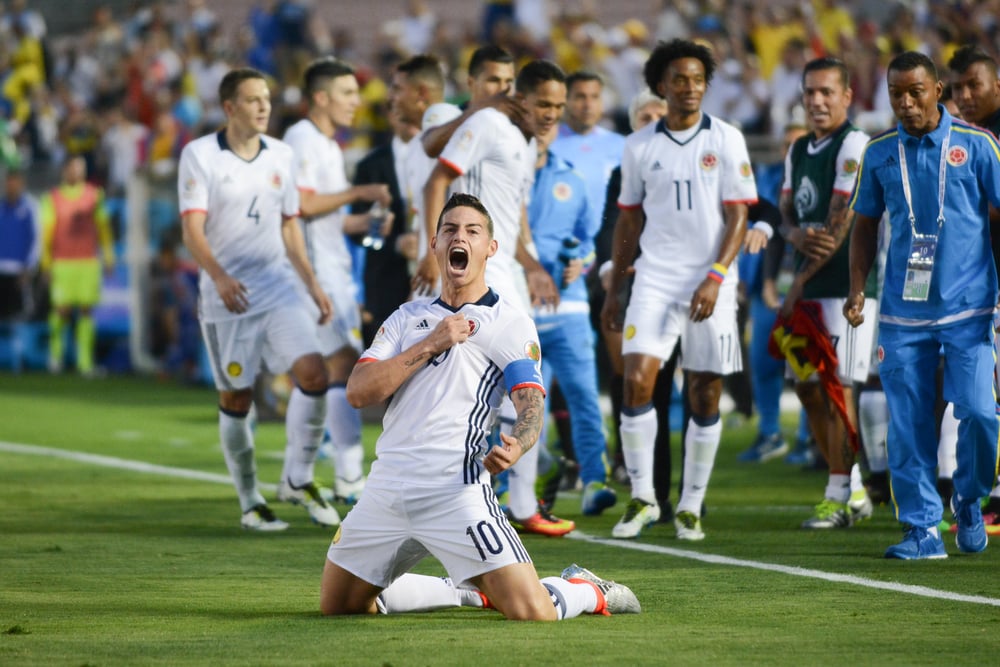
To understand what this Colombia World Cup 2026 campaign means, you first need to understand what Qatar 2022 felt like. Absent for the first time in 24 years, eliminated in a qualifying cycle that should have been routine – it was more than a sporting failure in Barranquilla and Bogota, it was a national rupture that demanded answers rather than explanations. Nestor Lorenzo, the Argentine coach handed an almost impossible brief, responded by making the decision that defined his tenure before it properly began: build the team around James Rodriguez when conventional wisdom said to move on. Time delivered its verdict emphatically. Los Cafeteros arrive at Group K with 28 points from 18 qualifying matches, James as the most statistically influential playmaker in South American qualification outside of Messi, and Luis Diaz as a world-class wide player who gives Colombia a dimension they have not possessed since Cuadrado’s best years. This Colombia World Cup 2026 campaign is a return planned carefully and executed with conviction.
Colombia’s Road: The Return From Exile
Missing Qatar 2022 still carries psychological weight in Colombia’s collective soccer memory, and that pain shaped everything Lorenzo built in the qualifying cycle that followed. The federation chose an Argentine coach with no prior national team head-coaching experience – a genuinely unusual decision under pressure to restore credibility quickly. Lorenzo’s response to that trust was the most consequential call of the campaign: maintain James Rodriguez as the creative axis despite his fractured club record and a growing narrative that his best years had already passed.
The numbers validated the decision emphatically. James delivered 6 goals and 8 assists across qualifying – results that positioned him alongside Lionel Messi as the two most influential individual creators in South American qualification. His capacity to find passes no other player on the pitch imagines, executed consistently across a gruelling 18-match campaign, silenced every critic who had declared him finished at the international level.
The qualifying record – 7 wins, 7 draws, 4 losses, 28 points, third in CONMEBOL – tells the story of a team that built correctly rather than brilliantly. Their home fortress at the Metropolitano de Barranquilla delivered its traditional advantage: 6 victories and 3 draws in 9 home games, a near-invincible record that sends rival coaches to the fixture list with dread. Away from home, Colombia collected points where they could and accepted losses in Buenos Aires and Sao Paulo as unavoidable against the continent’s premier sides. Qualification was earned through accumulated quality over 18 months, not luck or escape.
Coach Lorenzo: Argentine Method, Colombian Flair
Nestor Lorenzo is, in the tradition of Argentine coaches who have reshaped South American soccer, a details man who builds systems around his personnel rather than personnel around pre-existing systems. Born in Argentina and developed as a coach through youth football and assistant roles, his formative connection to Colombian soccer came as Nestor Pekerman’s long-time assistant with Los Cafeteros – a role that gave him deep familiarity with Colombian soccer culture, its specific demands, and the personality types that thrive within it. When he took the head role, he was not starting from zero. He was starting from intimate knowledge.
His tactical framework can be described as structured fluidity: a clear defensive organization that coexists with genuine attacking ambition rather than sacrificing one for the other. Colombia’s qualifying record – 28 goals scored, 18 conceded, +10 goal differential – reflects that balance precisely. They were productive enough to rank among the continent’s top three scorers, disciplined enough that single-goal defeats remained single-goal defeats rather than escalating collapses.
The James Rodriguez decision was Lorenzo’s most important tactical choice because it was also a systemic one. He built the team to protect James physically – two midfield runners who cover the ground James can no longer consistently cover, a pressing system calibrated around James’s stamina rather than demanding the same output from him as from younger players – while maximizing his influence in the final third where his vision and technique remain exceptional. James operates between the opposition midfield and defence, finding passes that no teammate or opponent anticipates. The system creates conditions for that magic to occur rather than relying on James to create those conditions for himself.
The bench depth reinforces Lorenzo’s planning. Juan Fernando Quintero provides creative freshness in second halves; Daniel Munoz covers the right side in multiple roles; Jhon Arias adds pace when margins need protecting. The first 11 is a plan. The bench is a different plan for when the first one needs adjusting.
Colombia 2026 Roster & Key Players
The Colombia 2026 roster represents the most complete tactical balance the program has assembled since the Pekerman era produced a quarterfinal at Brazil 2014 – not necessarily the most talented roster in raw individual quality, but the most coherently constructed one around a clear tactical identity.
Luis Diaz – The World-Class Threat
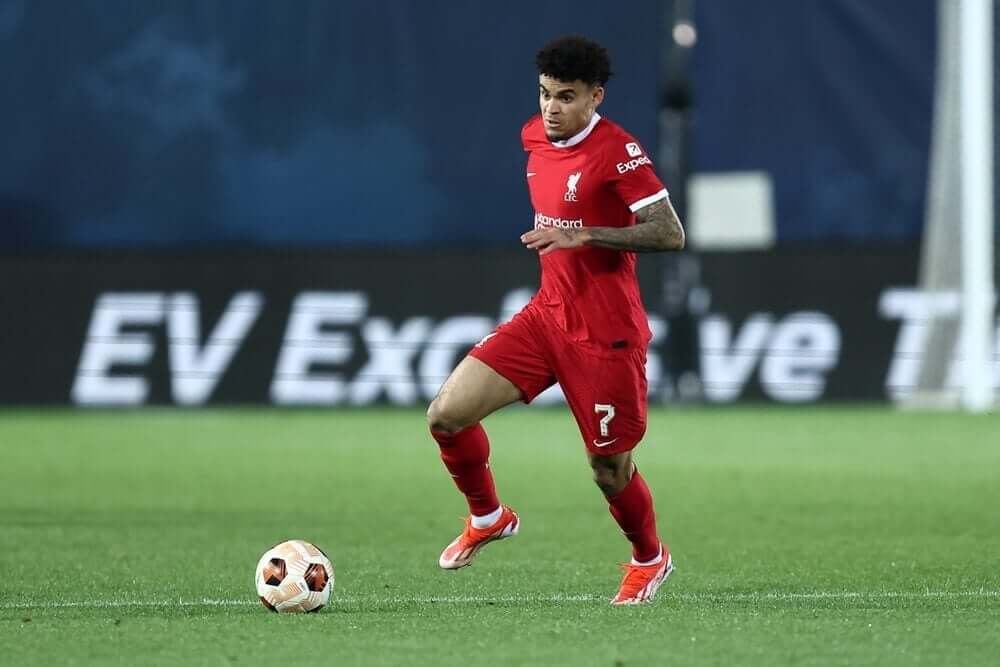
The Bayern winger enters this World Cup as Colombia’s undisputed world-class player – the one opponents plan defensive schemes for, the one whose presence dictates how defences organize before the match has even started. His combination of elite-level pace, dribbling unpredictability, and improving finishing makes him a genuine threat against any lateral defender on the planet. In qualifying, Diaz scored 5 goals and contributed 4 assists while consistently drawing double-marking defensive attention – numbers that would be higher if he operated with single coverage. His understanding with James has grown across three years of shared international football into something genuinely special: James finds Diaz with perfectly weighted through-passes that exploit his acceleration; Diaz returns the ball when the individual play is denied and the team needs to reset. No defensive solution cleanly neutralizes both players at once.
James Rodriguez – The Creator Who Defies Time
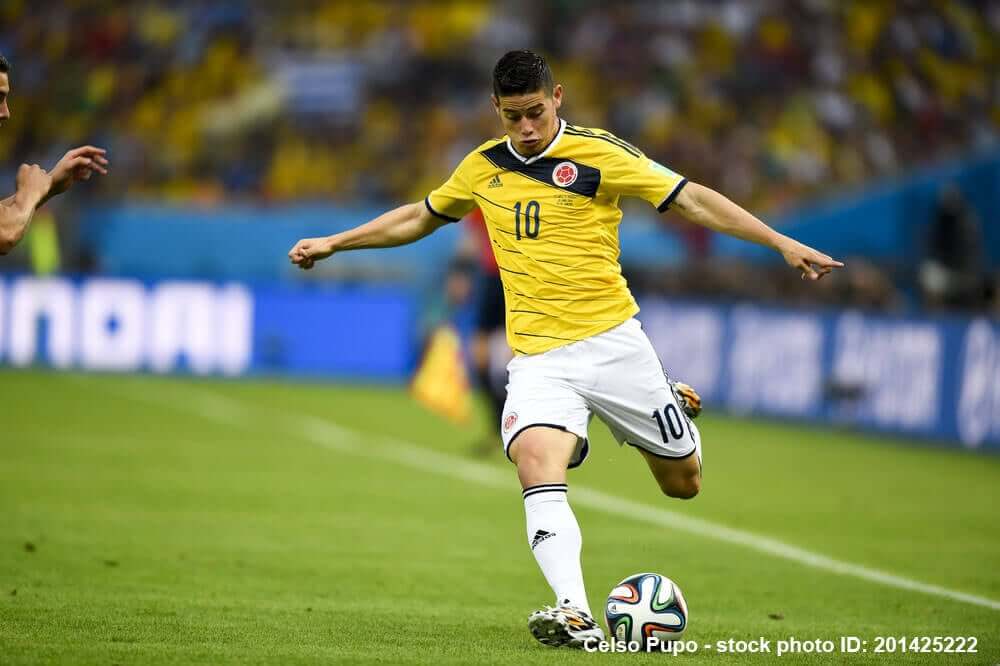
At 34, James Rodriguez should have been a secondary figure in Colombia’s World Cup planning. Instead he is the primary one. Six goals and eight assists in qualifying established him as the campaign’s most statistically impactful playmaker in South America. His through-passes split defensive lines with geometric precision; his dead-ball delivery creates scoring opportunities other players cannot manufacture from the same positions; his reading of a match’s rhythm allows him to accelerate or slow the tempo as tactical situations demand. Whether James chooses this Colombia World Cup 2026 campaign as his career’s great farewell performance remains to be seen – but the motivation to make it unforgettable is transparently present every time he wears the Cafeteros shirt.
Rafael Santos Borre – The Clinical Reference
Colombia’s historic difficulty in finding a reliable penalty-area finisher has been addressed by Borre’s steady, uncelebrated development. The centre forward converts clear chances without needing 10 opportunities to score once – a quality that sounds basic but was genuinely absent from previous Colombian qualifying campaigns. His 7 qualifying goals led the team, including decisive doubles against Bolivia and Venezuela that secured critical points in high-pressure fixtures. His link play has improved enough that James and Diaz can exploit the spaces Borre creates by fixing centre backs, rather than having to create those spaces themselves.
Davinson Sanchez – The Maturing Leader
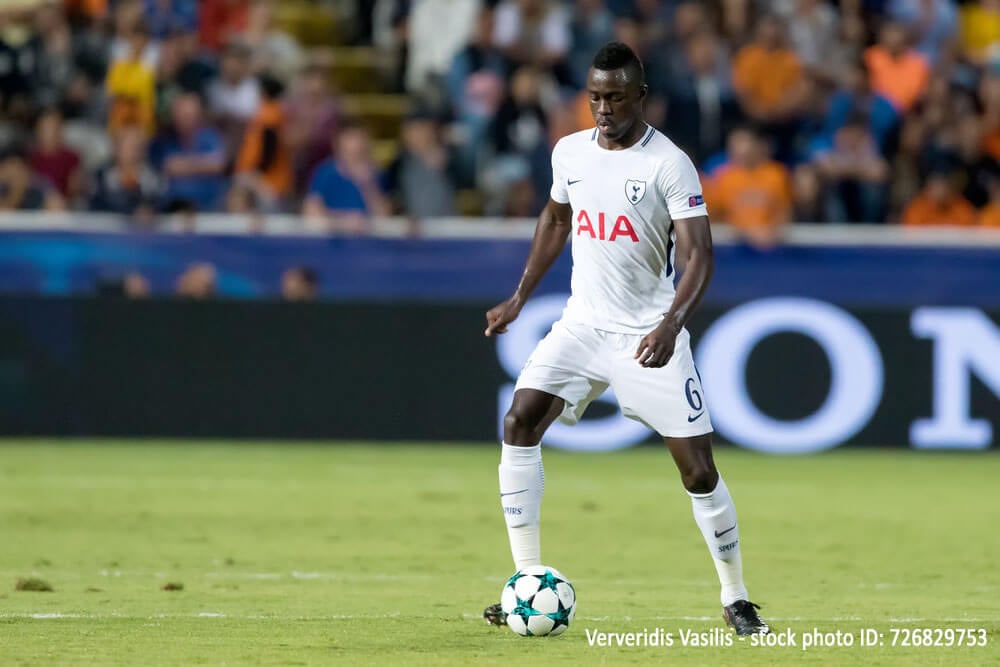
The centre back has completed the development arc that his early Tottenham career suggested but hadn’t yet delivered. At 29, Sanchez now makes positional decisions – when to step and intercept, when to hold the line – with the calculation of a veteran rather than the impulse of a young defender proving himself. His communication with Yerry Mina has tightened the defensive unit considerably, and the back line they organize together is noticeably more stable than what Colombia fielded four years ago.
Richard Rios – The Cycle’s Revelation
The midfielder emerged as this qualifying campaign’s most important discovery – a dynamic runner who adds a modern box-to-box dimension that Colombia’s midfield previously lacked. Rios presses, arrives late into the area, recovers quickly, and conducts defensive transitions with an urgency that makes the double pivot with Wilmar Barrios far more functionally complete than either player would be without the other.
Camilo Vargas – The Quiet Foundation
Colombia’s goalkeeper has consolidated the No. 1 position through consistent, unglamorous excellence. Secure in handling, reliable with his feet in build-up sequences, and effective in organizing his defensive line – Vargas is not spectacular, which for a tournament goalkeeper is very often exactly the right quality to possess.
Strengths & Weaknesses
Colombia’s primary competitive strength is the combination of Diaz and James – two players whose interaction has developed across three qualifying years into a partnership that creates specific defensive problems with no clean solution. Teams that concentrate resources on Diaz leave James in space; teams that track James allow Diaz to operate with single coverage he routinely beats. The interplay generates compounding problems rather than isolated ones, and Lorenzo’s system is built entirely around making that combination as dangerous as possible for as many minutes as possible.
The team’s second strength is attacking variety from the bench. Quintero, Arias, and Cordoba offer three genuinely different attacking profiles in reserve – creativity, pace, and physicality respectively – meaning Lorenzo can change the attacking character of matches rather than simply substituting like for like. That adaptability has been decisive in qualifying second halves.
The core defensive vulnerability is fragility against high-quality European attacking combinations, particularly balls played in behind a defensive line that lacks elite recovery pace. Portugal’s attack – with runners capable of exploiting depth behind the defensive shape – presents exactly the threat profile that Sanchez and Mina struggle with most consistently. Pre-tournament friendlies against Spain, Germany, and France produced goals that revealed this vulnerability repeatedly.
The secondary weakness is James’s physical limitation. At 34, he cannot press for 90 minutes, and opponents who identify this deploy a specific high press targeting him – forcing Colombia into defensive mode, which suits James not at all. Protecting him from high-press situations early in matches is one of Lorenzo’s most delicate tactical responsibilities throughout the tournament.
Ver esta publicación en Instagram
CONMEBOL Qualifying: A Statement Return
Colombia’s qualification after missing Qatar 2022 was achieved with a conviction the federation needed as much as the fans did. Twenty-eight points from 18 matches, third in the South American table, +10 goal differential with 28 scored and 18 conceded – none of this reads like a team scrambling through. It reads like a team building correctly across a full cycle. The Metropolitano de Barranquilla recorded a near-perfect home record: 6 wins and 3 draws from 9 home fixtures, confirming its reputation as one of the continent’s most hostile venues for visiting sides.
One of the qualifying campaign’s defining statistical features was the extraordinary tightness at the top of the table. Colombia, Uruguay, Brazil, and Paraguay all finished on exactly 28 points – four teams separated only by goal differential and goals scored tiebreakers. Colombia’s ranking of third above all three reflects the margin-level quality of South American competition and the importance of maximizing every single point across the full 18-match marathon.
| Pos | Team | P | W | D | L | GF | GA | GD | Pts |
| 1 | Argentina | 18 | 12 | 2 | 4 | 31 | 10 | +21 | 38 |
| 2 | Ecuador | 18 | 8 | 8 | 2 | 14 | 5 | +9 | 29 |
| 3 | Colombia | 18 | 7 | 7 | 4 | 28 | 18 | +10 | 28 |
| 4 | Uruguay | 18 | 7 | 7 | 4 | 22 | 12 | +10 | 28 |
| 5 | Brazil | 18 | 8 | 4 | 6 | 24 | 17 | +7 | 28 |
| 6 | Paraguay | 18 | 7 | 7 | 4 | 14 | 10 | +4 | 28 |
World Cup History: From Stigma to Quarterfinal
Colombia’s World Cup relationship is defined by two contrasting eras: decades of promise unfulfilled, and the golden generation of 2014 that finally delivered a result commensurate with the nation’s talent. Their debut came at Chile 1962, a modest first appearance followed by a long absence before returns in 1990 (Italy) and 1994 (USA) – the latter tournament permanently shadowed by the murder of Andres Escobar following his own goal against the United States, a tragedy that cast a long shadow over Colombian soccer’s relationship with the competition.
A return in France 1998 brought another group-stage exit before the long wait – coaching changes, failed cycles, near-misses – until Pekerman’s brilliant 2014 roster in Brazil. Colombia defeated Uruguay, Ivory Coast, Greece, and Japan en route to a quarterfinal loss to the hosts. James Rodriguez claimed the Golden Boot with 6 goals and produced the tournament’s goal of the tournament against Uruguay – a first-touch volley that remains among the sport’s most beautiful moments on the biggest stage. The 2018 campaign in Russia produced a round-of-16 exit to England on penalties. Then 2022 brought the silence that made 2026 necessary.
In 2026, Colombia make their seventh World Cup appearance. The mission is clear: reclaim the legacy that one missed cycle cannot erase.
Ver esta publicación en Instagram
Group K Fixtures & Match Schedule (All times Eastern Time)
Group K pairs Colombia with Portugal, Uzbekistan, and DR Congo. Portugal represent the group’s primary obstacle – a European side with individual quality capable of troubling any defence, led by Bruno Fernandes, Bernardo Silva, and Rafael Leao in their collective prime. Uzbekistan arrive with ambition but acknowledged limitations against South American and European competition at this level. Colombia’s path to the round of 16 involves banking six points from Uzbekistan and DR Congo before the defining encounter with Portugal that will determine group leadership.
The Colombia v Portugal fixture on June 27 in Miami at 7:30 PM ET is one of the tournament’s group-stage marquee matches – prime time for Canadian viewers on TSN and DAZN, and a match that will generate an extraordinary atmosphere inside Hard Rock Stadium. Both Houston fixtures (Central Time) kick off at 2:00 PM ET for eastern Canadian viewers.
| Date | Time (ET) | Match | Venue |
| Wed, June 17 | 2:00 PM | Portugal v DR Congo/Jamaica | NRG Stadium, Houston |
| Wed, June 17 | 11:00 PM | Uzbekistan v Colombia | Estadio Azteca, Mexico City |
| Tue, June 23 | 2:00 PM | Portugal v Uzbekistan | NRG Stadium, Houston |
| Tue, June 23 | 11:00 PM | Colombia v DR Congo/Jamaica | Estadio Akron, Guadalajara |
| Sat, June 27 | 7:30 PM | Colombia v Portugal | Hard Rock Stadium, Miami |
| Sat, June 27 | 7:30 PM | DR Congo/Jamaica v Uzbekistan | Mercedes-Benz Stadium, Atlanta |
Ver esta publicación en Instagram
Colombia World Cup Odds & Our Prediction
Colombia’s Colombia World Cup odds to win the 2026 tournament sit between 40.00 and 50.00 at Canadian sportsbooks – positioning them as a meaningful outsider with realistic deep-run potential rather than simply an optimistic participant. My model assigns roughly 3% championship probability, making prices above 33.00 technically positive-expected-value. But the realistic conversation for bettors is not about winning the whole tournament – it is about reaching the quarterfinals, which this roster has the talent and tactical framework to do.
The “Colombia to reach the quarterfinals” market in the 3.50-4.00 range represents the strongest value in this section of the betting landscape. Their path assumes Group K qualification – which their roster clearly favours even accounting for Portugal – followed by a knockout draw that could produce a manageable opponent in the round of 16 before a quarterfinal clash with a continental power. My probability for reaching the quarterfinals: approximately 35%, making prices above 2.85 technically attractive.
For individual match markets, “Colombia to win by 2+ goals” against Uzbekistan in the 1.80-2.00 range merits consideration given the quality differential and Colombia’s motivation to build strong goal differential before the Portugal fixture. “Luis Diaz anytime scorer” against Uzbekistan in the 2.20-2.50 range offers value given his consistent record against opponents he can run at freely with space in behind.
Avoid “Colombia clean sheet” markets in the Portugal match. Their defensive record against European high-press attacking combinations has shown vulnerabilities that pre-tournament friendlies repeatedly exposed. Portugal’s attack has the variety and individual quality to eventually find answers regardless of how well Colombia’s defensive block functions in the early stages.
For in-play bettors, note a consistent Lorenzo pattern: Colombia tends to begin matches evaluating the opponent in the first 20 minutes before accelerating in the 25-45 minute window. Goals in that band arrive more frequently than in the opening quarter-hour, creating timing value for in-game markets at better pre-goal odds than Colombia’s overall reputation might suggest.
Prediction: Colombia advance second from Group K, defeat a manageable round-of-16 opponent, and test a European heavyweight in the quarterfinals in a match decided by fine margins – James Rodriguez’s finest international farewell, regardless of the ultimate destination.
Colombia’s 2026 chapter is a comeback story that the sport occasionally produces and that fans remember long after the results fade. Whether James and Diaz deliver their ceiling simultaneously, and whether Lorenzo’s system holds against European pressure, will determine how far this team travels. Follow the complete 2026 World Cup hub and all World Cup 2026 groups for the latest standings and analysis throughout the tournament.